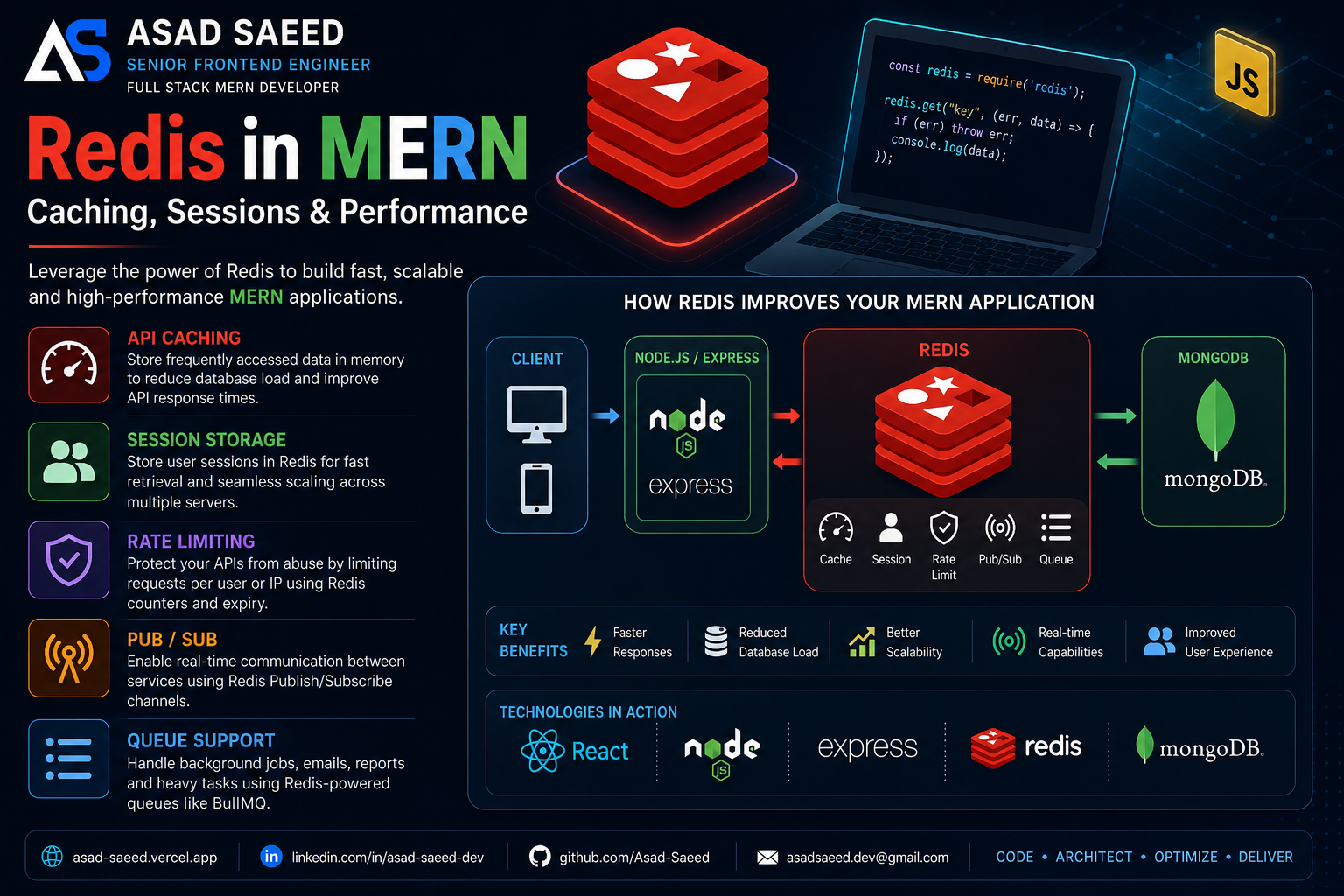
Redis in MERN: Caching, Sessions & Performance — A Practical Guide for Scalable Applications (2026)
Learn how Redis improves MERN applications with API caching, session storage, rate limiting, Pub/Sub messaging, queues, and performance optimization. A practical guide for building fast and scalable Node.js applications.
Introduction
As your MERN application grows, database queries become more frequent, API response times increase, and handling thousands of concurrent users becomes more challenging.
Many developers try to solve these problems by upgrading their server or optimizing MongoDB queries. While these improvements help, one technology can dramatically boost your application’s performance with minimal effort:
Redis
Redis is one of the most widely used in-memory data stores, trusted by companies like GitHub, Shopify, Discord, and Stack Overflow to power fast, scalable applications.
But Redis is much more than a cache. It can also manage sessions, implement rate limiting, power real-time messaging, and process background jobs.
In this guide, we’ll explore how Redis fits into a modern MERN stack and when to use its core features.
What is Redis?
Redis (Remote Dictionary Server) is an open-source, in-memory key-value database.
Unlike MongoDB, which stores data on disk, Redis keeps data primarily in memory (RAM), making it extremely fast for read and write operations.
Client Request
      │
      ▼
Node.js Server
      │
      ├── MongoDB (Persistent Storage)
      │
      └── Redis (In-Memory Cache)
Think of Redis as a high-speed layer that sits between your application and your database, reducing unnecessary database access.
Why Use Redis in MERN Applications?
Without Redis:
Client
   │
   ▼
Express API
   │
   ▼
MongoDB
Every request hits the database.
With Redis:
Client
   │
   ▼
Express API
   │
   ├── Redis Cache
   │      │
   │      └── Cache Hit ✅
   │
   └── MongoDB (Cache Miss)
Frequently requested data is served directly from Redis, reducing database load and improving response times.
1. API Caching
What is API Caching?
API caching stores the response of expensive or frequently accessed API requests in Redis.
Instead of querying MongoDB every time, your server first checks Redis.
If the data exists, it’s returned immediately. If not, the server fetches it from MongoDB, stores it in Redis, and returns the response.
User Request
      │
      ▼
Check Redis
      │
 ┌────┴────┐
 │         │
Hit ✅    Miss ❌
 │         │
 │     Query MongoDB
 │         │
 │     Store in Redis
 │         │
 └─────────┘
      │
      ▼
Return Response
Benefits
Faster API responses
Reduced MongoDB queries
Lower server load
Improved scalability
Best Use Cases
Product catalogs
Dashboard statistics
Frequently accessed settings
Public APIs
Blog posts
Search results
2. Session Storage
Why Store Sessions in Redis?
If your application uses session-based authentication, storing sessions in server memory isn’t ideal.
Problems include:
Sessions disappear after server restart.
Sessions aren’t shared across multiple servers.
Difficult to scale horizontally.
Redis solves these issues by storing sessions centrally.
User Login
     │
     ▼
Express Session
     │
     ▼
Redis Session Store
     │
     ▼
Session ID Stored in Cookie
Benefits
Shared sessions across servers
Better scalability
Faster session retrieval
Reliable session persistence
Common Use Cases
Admin dashboards
Enterprise applications
SaaS platforms
Multi-server deployments
3. Rate Limiting
What is Rate Limiting?
Rate limiting protects your application by restricting how many requests a user or IP address can make within a specific period.
Without rate limiting, attackers can overwhelm your server with excessive requests.
Redis efficiently tracks request counts because of its fast in-memory operations.
Client
   │
   ▼
Redis Counter
   │
   ▼
Limit Reached?
   │
 ┌─┴─────┐
 │        │
No ✅    Yes ❌
 │        │
Allow   Return 429
Benefits
Protects APIs from abuse
Prevents brute-force attacks
Reduces server load
Improves application security
Common Examples
Login attempts
Password reset requests
OTP verification
Public APIs
Authentication endpoints
4. Pub/Sub (Publish/Subscribe)
What is Pub/Sub?
Redis Pub/Sub enables real-time communication between different parts of your application.
Instead of services communicating directly, messages are published to channels, and subscribers receive updates instantly.
Publisher
     │
     ▼
Redis Channel
     │
 ┌───┴────┐
 │        │
Subscriber A
Subscriber B
Subscriber C
Use Cases
Chat applications
Live notifications
Stock price updates
Real-time dashboards
Multiplayer games
Benefits
Decoupled architecture
Low latency
Easy real-time messaging
5. Queue Support
Why Use Queues?
Some tasks shouldn’t block the user’s request.
For example:
Sending emails
Image processing
PDF generation
Video encoding
Report generation
Instead of processing these tasks immediately, they can be added to a queue.
User Uploads Image
        │
        ▼
Express API
        │
        ▼
Redis Queue
        │
        ▼
Worker Processes Job
        │
        ▼
Task Completed
Popular queue libraries include BullMQ and Bull, both built on Redis.
Benefits
Faster user responses
Improved reliability
Automatic retries
Background processing
Better scalability
Performance Improvements with Redis
Let’s compare a typical API response flow.
Without Redis
Client
   │
   ▼
Node.js
   │
   ▼
MongoDB
   │
   ▼
Return Response
Every request queries the database.
With Redis
Client
   │
   ▼
Node.js
   │
   ▼
Redis
   │
 ┌──┴───┐
 │      │
Hit    Miss
 │      │
 │   MongoDB
 │      │
 └──────┘
   │
   ▼
Return Response
Frequently requested data is served directly from memory, reducing latency and improving scalability.
When Should You Use Redis?
Need Faster APIs?
        │
        ▼
Use Caching
────────────────────────Managing User Sessions?
│
▼
Use Session Storage────────────────────────Protecting APIs?
│
▼
Use Rate Limiting────────────────────────Real-Time Notifications?
│
▼
Use Pub/Sub────────────────────────Background Jobs?
│
▼
Use Redis QueuesBest Practices
✔ Cache frequently accessed data, not everything.
✔ Set expiration times (TTL) for cached data to avoid serving stale information.
✔ Invalidate cache when underlying data changes.
✔ Don’t store sensitive information in Redis without proper security measures.
✔ Use Redis alongside MongoDB — not as a replacement.
✔ Monitor memory usage and configure eviction policies for production environments.
Common Mistakes
❌ Caching every API response without a strategy.
❌ Forgetting to invalidate stale cache.
❌ Storing permanent data only in Redis.
❌ Using Redis as the primary database for all application data.
❌ Ignoring authentication and access controls for your Redis instance.
Final Thoughts
Redis is much more than a caching tool. It’s a versatile component that can significantly improve the performance, scalability, and reliability of MERN applications.
By using Redis effectively, you can:
Accelerate API responses with caching.
Manage sessions across multiple servers.
Protect APIs with rate limiting.
Enable real-time communication through Pub/Sub.
Offload heavy tasks to background queues.
Rather than replacing MongoDB, Redis complements it by handling operations where speed and efficiency matter most. As your application grows, incorporating Redis into your architecture can help deliver a faster and more resilient user experience.
About the Author
Asad Saeed
Senior Frontend Engineer | Full Stack MERN Developer
I build scalable web and mobile applications using React.js, Next.js, React Native, TypeScript, Node.js, Express.js, NestJS, MongoDB, PostgreSQL, Redis, AWS, Docker, and modern CI/CD pipelines.
Connect with Me
🌐 Portfolio: https://asad-saeed.vercel.app/
💼 LinkedIn: https://linkedin.com/in/asad-saeed-dev
💻 GitHub: https://github.com/Asad-Saeed
📧 Email: asadsaeed.dev@gmail.com
Follow for more content on:
MERN Stack
Redis
Node.js
Express.js
MongoDB
Next.js
React
Backend Architecture
System Design
AWS & Cloud
CI/CD
Software Engineering
#Redis #MERN #NodeJS #ExpressJS #MongoDB #React #NextJS #Caching #BackendDevelopment #SystemDesign #SoftwareEngineering #WebDevelopment #AsadSaeed