Skip to main contentSkip to main content
~/profileLIVE
Asad Saeed
Asad SaeedOpen to WorkSenior Frontend Engineer | MERN Stack Developer
01

Identity

Residence
Lahore, Punjab
Nationality
Pakistani
City
Lahore
Age
26
02

Languages

  • English96%
  • Urdu100%
03

Expertise

React.js95%
Next.js95%
JavaScript / TypeScript95%
HTML5, CSS395%
Tailwind, Bootstrap, Shadcn UI95%
Material UI, SCSS, Styled Components90%
Redux Toolkit, React Query, Zustand92%
REST & GraphQL APIs92%
Git, GitHub, Bitbucket98%
Node.js, Express.js, NestJS85%
MongoDB, PostgreSQL, Prisma80%
WebSockets, Real-Time Systems82%
AI & Automation (n8n, OpenAI)78%
04

Stack

4949 technologies
ReactJSNextJSJavaScriptTypeScriptReact NativeNestJSNode.jsExpress.jsMongoDBPostgreSQLMySQLPrisma ORMFirebaseREST APIGraphQL APIApollo ClientWebSockets / Socket.ioReduxRedux ToolkitReact QueryZustandTailwind CSSShadcn UIMaterial UIBootstrapSCSSCSSModule.cssStyled ComponentsFramer MotionStripe Payment Integrationn8nOpenAI APIAWS LambdaDockerVercelNetlifyGitHub Actions (CI/CD)JestGitGitHubBitbucketPostmanSwaggerJira SoftwareStrapiSanityFigmaAdobe XD
05

Contact

Email
asadsaeed.dev@gmail.com
Phone
+92 3017631644·+92 478730644
Download Resume
HomeSkillsBackgroundPortfolioContact
Chat with Asad
All Posts
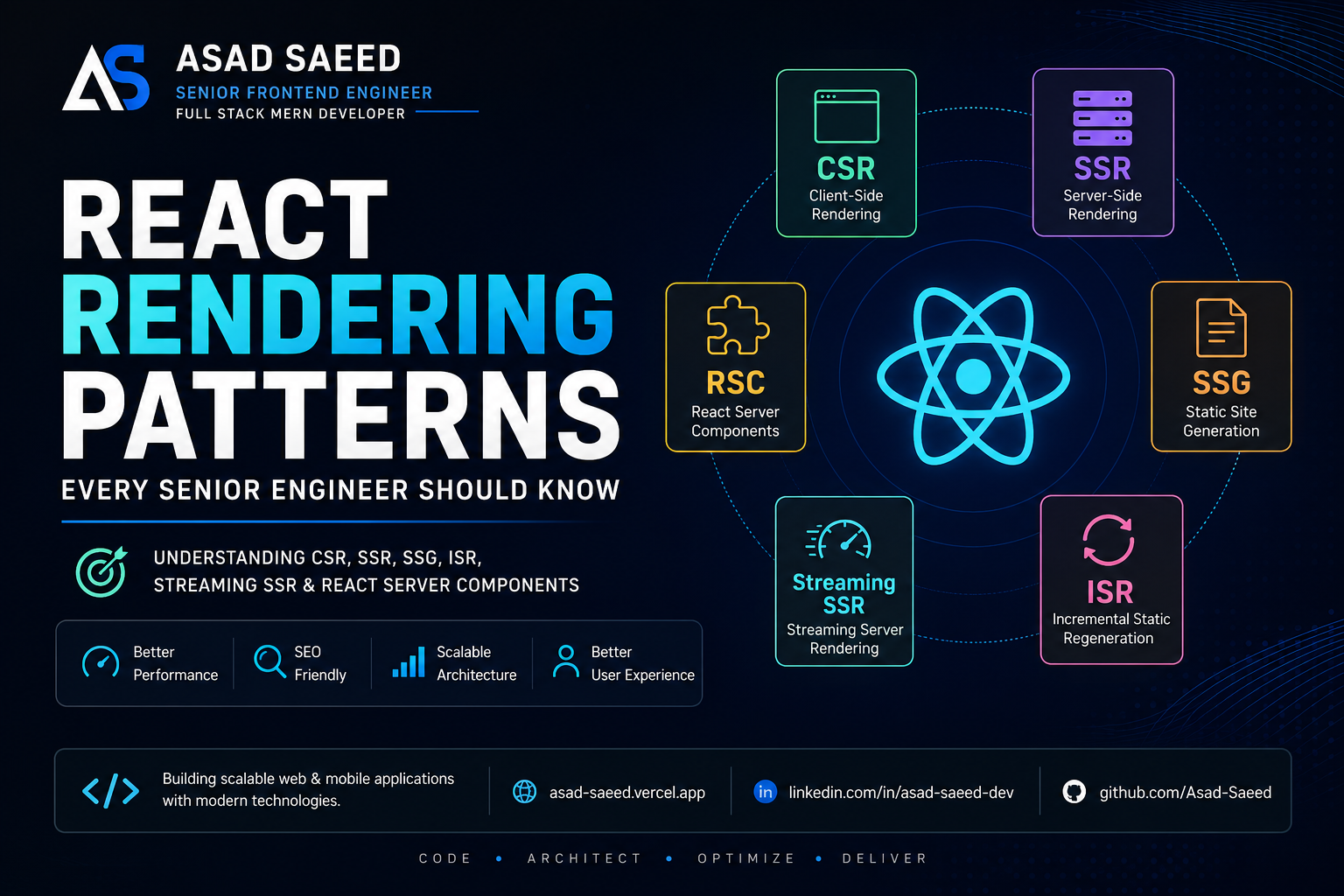
React Rendering Patterns Every Senior Engineer Should Know (2026)

React Rendering Patterns Every Senior Engineer Should Know (2026)

REACTSSRISRCSRREACT SERVER COMPONENTSERVER SIDE RENDERINGCLIENT SIDE RENDERINGMERN STACK DEVELOPERASAD SAEED
July 4, 20266 min readBy Asad Saeed

Understanding CSR, SSR, SSG, ISR, Streaming SSR & React Server Components

Introduction

One of the biggest misconceptions about React is that it has only one way to render an application. In reality, modern React and Next.js provide multiple rendering strategies, each designed to solve different problems.

Choosing the right rendering pattern directly affects your application's:

  • ⚡ Performance

  • 🔍 SEO

  • 📱 User Experience

  • 📈 Scalability

  • 💰 Infrastructure Cost

  • 🚀 Core Web Vitals

As a senior engineer, understanding when to use each rendering strategy is more valuable than simply knowing how to implement it.

In this guide, we'll explore the six primary React rendering patterns, their advantages, disadvantages, and real-world use cases.


React Rendering Evolution

React Rendering

│
├── Client-Side Rendering (CSR)
│
├── Server-Side Rendering (SSR)
│
├── Static Site Generation (SSG)
│
├── Incremental Static Regeneration (ISR)
│
├── Streaming Server Rendering
│
└── React Server Components (RSC)

Each rendering strategy exists for a different purpose. Let's explore them.


1. Client-Side Rendering (CSR)

What is CSR?

Client-Side Rendering means the browser is responsible for rendering the application. The server sends a minimal HTML page along with JavaScript bundles. React downloads the JavaScript, fetches data from APIs, and renders the UI in the browser.

How It Works

Browser
    │
    ▼
Downloads HTML
    │
    ▼
Downloads JavaScript
    │
    ▼
React Executes
    │
    ▼
API Calls
    │
    ▼
UI Becomes Interactive

Advantages

✅ Rich user interactions

✅ Fast client-side navigation

✅ Lower server workload

✅ Great developer experience

Disadvantages

❌ Poor SEO

❌ Slower initial page load

❌ Large JavaScript bundles

❌ More work performed by the browser

Best Use Cases

  • Admin Dashboards

  • CRM & ERP Systems

  • Analytics Platforms

  • Internal Business Applications

  • Chat Applications

Recommendation: Use CSR when SEO isn't important and users spend most of their time interacting with the application after logging in.


2. Server-Side Rendering (SSR)

What is SSR?

Server-Side Rendering generates the HTML on the server before sending it to the browser. Users receive fully rendered HTML immediately, making pages faster to display and easier for search engines to index.

How It Works

Browser
    │
    ▼
Request
    │
    ▼
Server Renders React
    │
    ▼
Returns HTML
    │
    ▼
Hydration
    │
    ▼
Interactive UI

Advantages

✅ Excellent SEO

✅ Faster First Contentful Paint

✅ Better user experience

✅ Dynamic content rendered on every request

Disadvantages

❌ Increased server workload

❌ Higher hosting costs

❌ Slightly slower response under heavy traffic without caching

Best Use Cases

  • News Websites

  • Blogs

  • Product Pages

  • Landing Pages

  • Search Results

Recommendation: Use SSR whenever pages contain frequently changing public content that should be indexed by search engines.


3. Static Site Generation (SSG)

What is SSG?

Static Site Generation creates HTML files during the build process. Instead of generating pages for every visitor, pre-built HTML is served directly from a CDN.

How It Works

Build Time
    │
    ▼
Generate HTML
    │
    ▼
Deploy
    │
    ▼
Serve Static Files

Advantages

✅ Extremely fast

✅ Excellent SEO

✅ Low hosting costs

✅ Easy CDN caching

Disadvantages

❌ Content updates require rebuilding the application

❌ Not suitable for frequently changing data

Best Use Cases

  • Documentation

  • Marketing Websites

  • Company Websites

  • Portfolio Websites

  • Landing Pages

Recommendation: If your content changes infrequently, SSG is usually the fastest and most cost-effective solution.


4. Incremental Static Regeneration (ISR)

What is ISR?

Incremental Static Regeneration combines the speed of static generation with the flexibility of server-side rendering. Pages are initially generated as static files but can automatically regenerate in the background after a specified interval.

How It Works

User Request
      │
      ▼
Serve Cached Page
      │
      ▼
Background Regeneration
      │
      ▼
Updated Static Page

Advantages

✅ Static performance

✅ Fresh content

✅ Reduced build times

✅ Better scalability

Disadvantages

❌ Slightly more complex to configure

❌ Cached content may remain visible until regeneration occurs

Best Use Cases

  • E-commerce Stores

  • Product Catalogs

  • Blogs

  • News Platforms

  • Frequently Updated Websites

Recommendation: Use ISR when you need static performance while keeping content reasonably up to date.


5. Streaming Server Rendering

What is Streaming SSR?

Streaming Server Rendering allows the server to send parts of a page to the browser as soon as they are ready, rather than waiting for the entire page to finish rendering.

How It Works

Request
   │
   ▼
Server Starts Rendering
   │
   ├────────► Header Sent
   │
   ├────────► Navigation Sent
   │
   ├────────► Content Streams
   │
   └────────► Remaining UI Loads

Advantages

✅ Faster perceived performance

✅ Better user experience

✅ Works seamlessly with React Suspense

Disadvantages

❌ More complex architecture

❌ Requires React 18+ compatible frameworks

Best Use Cases

  • Large Dashboards

  • Enterprise Applications

  • Data-Heavy Pages

  • SaaS Platforms

Recommendation: Use Streaming SSR to improve perceived performance for complex applications with multiple asynchronous data sources.


6. React Server Components (RSC)

What are React Server Components?

React Server Components allow components to execute entirely on the server. Instead of sending JavaScript to the browser, only the rendered result is delivered, reducing bundle sizes and improving performance.

How It Works

Client Request
      │
      ▼
Server Component Executes
      │
      ▼
Fetch Data
      │
      ▼
Render HTML
      │
      ▼
Send Result to Browser

Advantages

✅ Smaller JavaScript bundles

✅ Faster page loads

✅ Improved SEO

✅ Better server-side data fetching

Disadvantages

❌ Not all libraries support Server Components

❌ Client-only features require Client Components

Best Use Cases

  • Product Pages

  • Blogs

  • Documentation

  • E-commerce Websites

  • Data-Driven Applications

Recommendation: In modern Next.js applications, prefer Server Components by default and use Client Components only where interactivity is required.


Which Rendering Pattern Should You Choose?

🏢 Admin Dashboard
→ Client-Side Rendering (CSR)

📰 Blog or News Website
→ Server-Side Rendering (SSR)

🌐 Company Website
→ Static Site Generation (SSG)

🛍️ E-commerce Store
→ Incremental Static Regeneration (ISR)

📊 Large SaaS Dashboard
→ Streaming SSR

⚡ Modern Next.js Applications
→ React Server Components + Client Components

Senior Engineer Tips

✔ Don't use one rendering strategy for every page.

✔ Choose rendering patterns based on business requirements—not personal preference.

✔ Default to React Server Components in modern Next.js applications.

✔ Use Client Components only for interactive features like forms, buttons, and local state.

✔ Measure performance using Core Web Vitals instead of making assumptions.

✔ Optimize for your users, not just your Lighthouse score.


Final Thoughts

React has evolved far beyond simple client-side rendering. Modern applications often combine multiple rendering strategies within the same project to achieve the best balance between performance, SEO, scalability, and user experience.

Understanding when to use CSR, SSR, SSG, ISR, Streaming SSR, and React Server Components is one of the key skills that separates a senior frontend engineer from someone who simply knows the framework.

Rather than asking "Which rendering pattern is best?", ask:

"Which rendering pattern best solves this business problem?"

The answer will almost always lead to a better architecture.


About the Author

Asad Saeed

Senior Frontend Engineer | Full Stack MERN Developer

I build scalable web and mobile applications using React.js, Next.js, React Native, TypeScript, Node.js, Express.js, NestJS, MongoDB, SQL, AWS, and modern CI/CD pipelines.

Connect with Me

🌐 Portfolio: https://asad-saeed.vercel.app/

💼 LinkedIn: https://linkedin.com/in/asad-saeed-dev

💻 GitHub: https://github.com/Asad-Saeed

📧 Email: asadsaeed.dev@gmail.com


Follow for more content on:

  • React.js

  • Next.js

  • React Native

  • TypeScript

  • Frontend Architecture

  • Full Stack Development

  • System Design

  • AWS & Cloud

  • CI/CD

  • Software Engineering

#React #NextJS #ReactJS #Frontend #SoftwareEngineering #WebDevelopment #JavaScript #TypeScript #ReactServerComponents #SSR #CSR #SSG #ISR #FrontendArchitecture #AsadSaeed

Asad Saeed

Asad Saeed

Senior Frontend Engineer | MERN Stack Developer

More posts →

Related Posts

Don't Stop Here

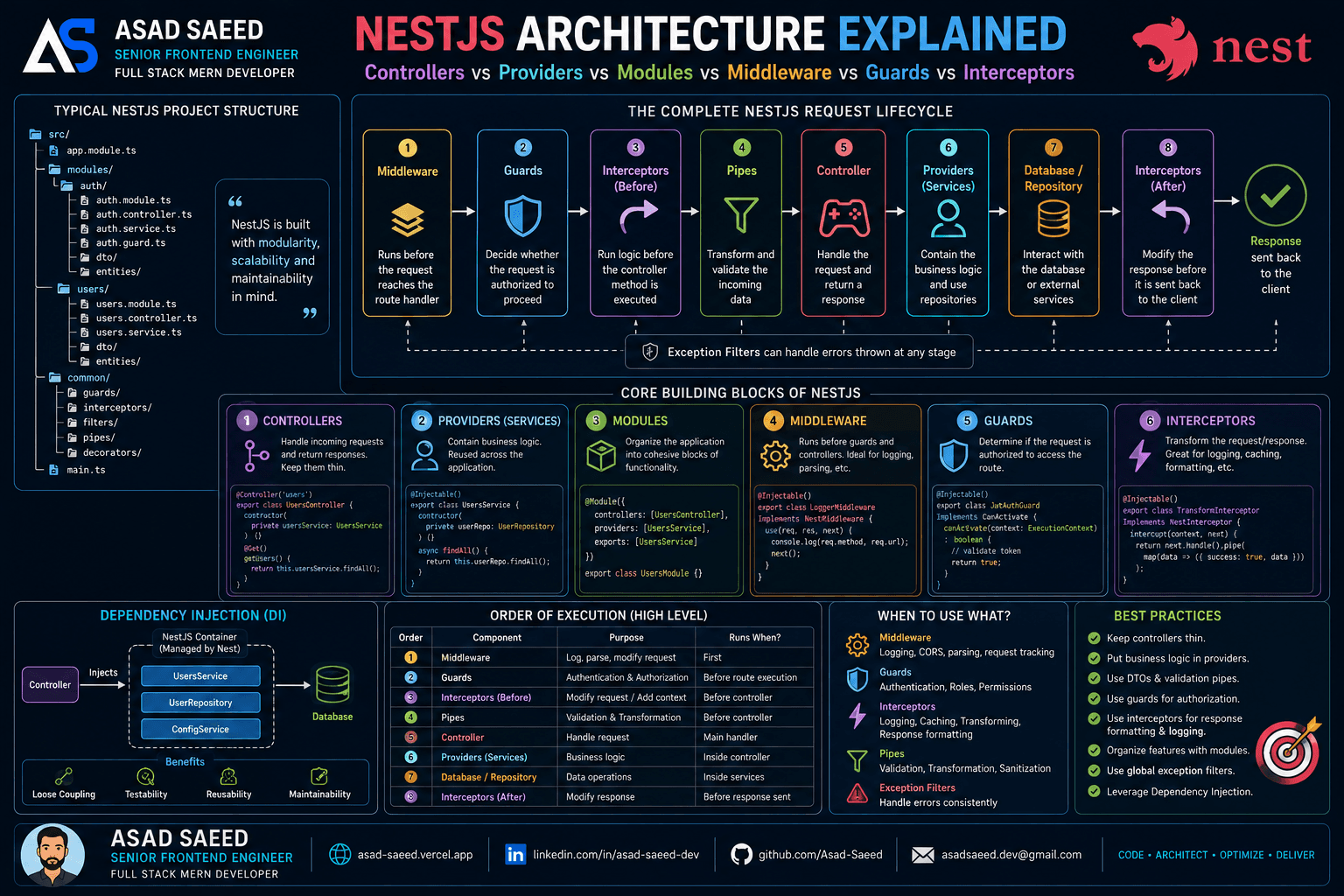
NestJS Architecture Explained: Controllers, Providers, Modules, Middleware, Guards & Interceptors (2026 Guide)

NestJS Architecture Explained: Controllers, Providers, Modules, Middleware, Guards & Interceptors (2026 Guide)

Master the NestJS architecture by understanding Modules, Controllers, Providers, Dependency Injection, Middleware, Guards, Pipes, Interceptors, and Exception Filters. Learn the complete NestJS request lifecycle and build scalable, production-ready backend applications.

NESTJSNODEJSSOFTWARE ARCHITECTURE
© 2026 · Asad Saeed
All Posts
React Rendering Patterns Every Senior Engineer Should Know (2026)

React Rendering Patterns Every Senior Engineer Should Know (2026)

REACTSSRISRCSRREACT SERVER COMPONENTSERVER SIDE RENDERINGCLIENT SIDE RENDERINGMERN STACK DEVELOPERASAD SAEED
July 4, 20266 min readBy Asad Saeed

Understanding CSR, SSR, SSG, ISR, Streaming SSR & React Server Components

Introduction

One of the biggest misconceptions about React is that it has only one way to render an application. In reality, modern React and Next.js provide multiple rendering strategies, each designed to solve different problems.

Choosing the right rendering pattern directly affects your application's:

  • ⚡ Performance

  • 🔍 SEO

  • 📱 User Experience

  • 📈 Scalability

  • 💰 Infrastructure Cost

  • 🚀 Core Web Vitals

As a senior engineer, understanding when to use each rendering strategy is more valuable than simply knowing how to implement it.

In this guide, we'll explore the six primary React rendering patterns, their advantages, disadvantages, and real-world use cases.


React Rendering Evolution

React Rendering

│
├── Client-Side Rendering (CSR)
│
├── Server-Side Rendering (SSR)
│
├── Static Site Generation (SSG)
│
├── Incremental Static Regeneration (ISR)
│
├── Streaming Server Rendering
│
└── React Server Components (RSC)

Each rendering strategy exists for a different purpose. Let's explore them.


1. Client-Side Rendering (CSR)

What is CSR?

Client-Side Rendering means the browser is responsible for rendering the application. The server sends a minimal HTML page along with JavaScript bundles. React downloads the JavaScript, fetches data from APIs, and renders the UI in the browser.

How It Works

Browser
    │
    ▼
Downloads HTML
    │
    ▼
Downloads JavaScript
    │
    ▼
React Executes
    │
    ▼
API Calls
    │
    ▼
UI Becomes Interactive

Advantages

✅ Rich user interactions

✅ Fast client-side navigation

✅ Lower server workload

✅ Great developer experience

Disadvantages

❌ Poor SEO

❌ Slower initial page load

❌ Large JavaScript bundles

❌ More work performed by the browser

Best Use Cases

  • Admin Dashboards

  • CRM & ERP Systems

  • Analytics Platforms

  • Internal Business Applications

  • Chat Applications

Recommendation: Use CSR when SEO isn't important and users spend most of their time interacting with the application after logging in.


2. Server-Side Rendering (SSR)

What is SSR?

Server-Side Rendering generates the HTML on the server before sending it to the browser. Users receive fully rendered HTML immediately, making pages faster to display and easier for search engines to index.

How It Works

Browser
    │
    ▼
Request
    │
    ▼
Server Renders React
    │
    ▼
Returns HTML
    │
    ▼
Hydration
    │
    ▼
Interactive UI

Advantages

✅ Excellent SEO

✅ Faster First Contentful Paint

✅ Better user experience

✅ Dynamic content rendered on every request

Disadvantages

❌ Increased server workload

❌ Higher hosting costs

❌ Slightly slower response under heavy traffic without caching

Best Use Cases

  • News Websites

  • Blogs

  • Product Pages

  • Landing Pages

  • Search Results

Recommendation: Use SSR whenever pages contain frequently changing public content that should be indexed by search engines.


3. Static Site Generation (SSG)

What is SSG?

Static Site Generation creates HTML files during the build process. Instead of generating pages for every visitor, pre-built HTML is served directly from a CDN.

How It Works

Build Time
    │
    ▼
Generate HTML
    │
    ▼
Deploy
    │
    ▼
Serve Static Files

Advantages

✅ Extremely fast

✅ Excellent SEO

✅ Low hosting costs

✅ Easy CDN caching

Disadvantages

❌ Content updates require rebuilding the application

❌ Not suitable for frequently changing data

Best Use Cases

  • Documentation

  • Marketing Websites

  • Company Websites

  • Portfolio Websites

  • Landing Pages

Recommendation: If your content changes infrequently, SSG is usually the fastest and most cost-effective solution.


4. Incremental Static Regeneration (ISR)

What is ISR?

Incremental Static Regeneration combines the speed of static generation with the flexibility of server-side rendering. Pages are initially generated as static files but can automatically regenerate in the background after a specified interval.

How It Works

User Request
      │
      ▼
Serve Cached Page
      │
      ▼
Background Regeneration
      │
      ▼
Updated Static Page

Advantages

✅ Static performance

✅ Fresh content

✅ Reduced build times

✅ Better scalability

Disadvantages

❌ Slightly more complex to configure

❌ Cached content may remain visible until regeneration occurs

Best Use Cases

  • E-commerce Stores

  • Product Catalogs

  • Blogs

  • News Platforms

  • Frequently Updated Websites

Recommendation: Use ISR when you need static performance while keeping content reasonably up to date.


5. Streaming Server Rendering

What is Streaming SSR?

Streaming Server Rendering allows the server to send parts of a page to the browser as soon as they are ready, rather than waiting for the entire page to finish rendering.

How It Works

Request
   │
   ▼
Server Starts Rendering
   │
   ├────────► Header Sent
   │
   ├────────► Navigation Sent
   │
   ├────────► Content Streams
   │
   └────────► Remaining UI Loads

Advantages

✅ Faster perceived performance

✅ Better user experience

✅ Works seamlessly with React Suspense

Disadvantages

❌ More complex architecture

❌ Requires React 18+ compatible frameworks

Best Use Cases

  • Large Dashboards

  • Enterprise Applications

  • Data-Heavy Pages

  • SaaS Platforms

Recommendation: Use Streaming SSR to improve perceived performance for complex applications with multiple asynchronous data sources.


6. React Server Components (RSC)

What are React Server Components?

React Server Components allow components to execute entirely on the server. Instead of sending JavaScript to the browser, only the rendered result is delivered, reducing bundle sizes and improving performance.

How It Works

Client Request
      │
      ▼
Server Component Executes
      │
      ▼
Fetch Data
      │
      ▼
Render HTML
      │
      ▼
Send Result to Browser

Advantages

✅ Smaller JavaScript bundles

✅ Faster page loads

✅ Improved SEO

✅ Better server-side data fetching

Disadvantages

❌ Not all libraries support Server Components

❌ Client-only features require Client Components

Best Use Cases

  • Product Pages

  • Blogs

  • Documentation

  • E-commerce Websites

  • Data-Driven Applications

Recommendation: In modern Next.js applications, prefer Server Components by default and use Client Components only where interactivity is required.


Which Rendering Pattern Should You Choose?

🏢 Admin Dashboard
→ Client-Side Rendering (CSR)

📰 Blog or News Website
→ Server-Side Rendering (SSR)

🌐 Company Website
→ Static Site Generation (SSG)

🛍️ E-commerce Store
→ Incremental Static Regeneration (ISR)

📊 Large SaaS Dashboard
→ Streaming SSR

⚡ Modern Next.js Applications
→ React Server Components + Client Components

Senior Engineer Tips

✔ Don't use one rendering strategy for every page.

✔ Choose rendering patterns based on business requirements—not personal preference.

✔ Default to React Server Components in modern Next.js applications.

✔ Use Client Components only for interactive features like forms, buttons, and local state.

✔ Measure performance using Core Web Vitals instead of making assumptions.

✔ Optimize for your users, not just your Lighthouse score.


Final Thoughts

React has evolved far beyond simple client-side rendering. Modern applications often combine multiple rendering strategies within the same project to achieve the best balance between performance, SEO, scalability, and user experience.

Understanding when to use CSR, SSR, SSG, ISR, Streaming SSR, and React Server Components is one of the key skills that separates a senior frontend engineer from someone who simply knows the framework.

Rather than asking "Which rendering pattern is best?", ask:

"Which rendering pattern best solves this business problem?"

The answer will almost always lead to a better architecture.


About the Author

Asad Saeed

Senior Frontend Engineer | Full Stack MERN Developer

I build scalable web and mobile applications using React.js, Next.js, React Native, TypeScript, Node.js, Express.js, NestJS, MongoDB, SQL, AWS, and modern CI/CD pipelines.

Connect with Me

🌐 Portfolio: https://asad-saeed.vercel.app/

💼 LinkedIn: https://linkedin.com/in/asad-saeed-dev

💻 GitHub: https://github.com/Asad-Saeed

📧 Email: asadsaeed.dev@gmail.com


Follow for more content on:

  • React.js

  • Next.js

  • React Native

  • TypeScript

  • Frontend Architecture

  • Full Stack Development

  • System Design

  • AWS & Cloud

  • CI/CD

  • Software Engineering

#React #NextJS #ReactJS #Frontend #SoftwareEngineering #WebDevelopment #JavaScript #TypeScript #ReactServerComponents #SSR #CSR #SSG #ISR #FrontendArchitecture #AsadSaeed
Asad Saeed

Asad Saeed

Senior Frontend Engineer | MERN Stack Developer

More posts →

Related Posts

Don't Stop Here

NestJS Architecture Explained: Controllers, Providers, Modules, Middleware, Guards & Interceptors (2026 Guide)

NestJS Architecture Explained: Controllers, Providers, Modules, Middleware, Guards & Interceptors (2026 Guide)

Master the NestJS architecture by understanding Modules, Controllers, Providers, Dependency Injection, Middleware, Guards, Pipes, Interceptors, and Exception Filters. Learn the complete NestJS request lifecycle and build scalable, production-ready backend applications.

NESTJSNODEJSSOFTWARE ARCHITECTURE
© 2026 · Asad Saeed
Aug 5, 20266 min read
Read
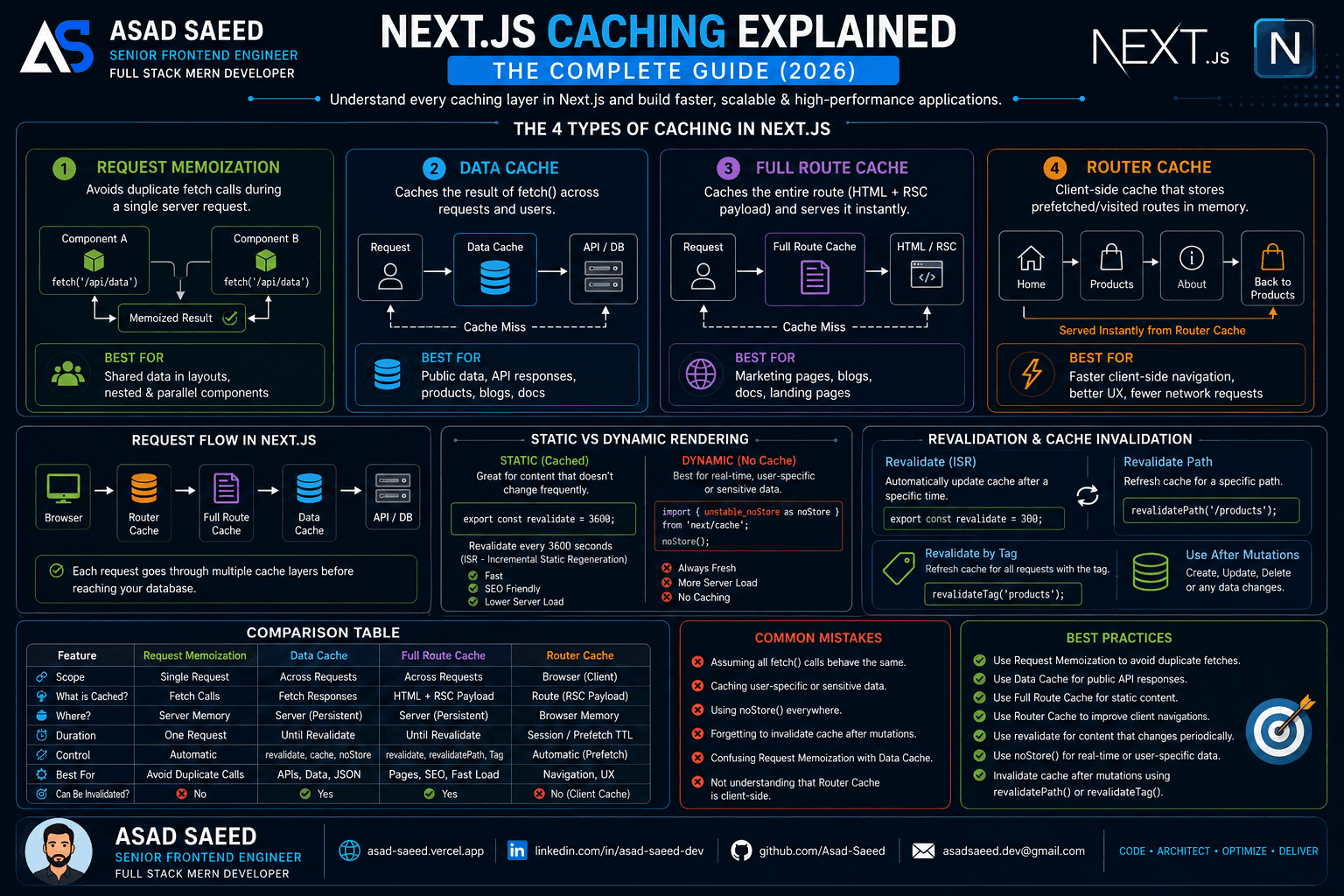
Next.js Caching Explained: Request Memoization, Data Cache, Full Route Cache & Router Cache (2026 Guide)

Next.js Caching Explained: Request Memoization, Data Cache, Full Route Cache & Router Cache (2026 Guide)

Learn how Next.js caching works with Request Memoization, Data Cache, Full Route Cache, Router Cache, ISR, revalidation, and cache invalidation. A practical guide for building high-performance, scalable Next.js applications.

NEXT.JSREACT.JSWEB PERFORMANCE
Jul 31, 20266 min read
Read
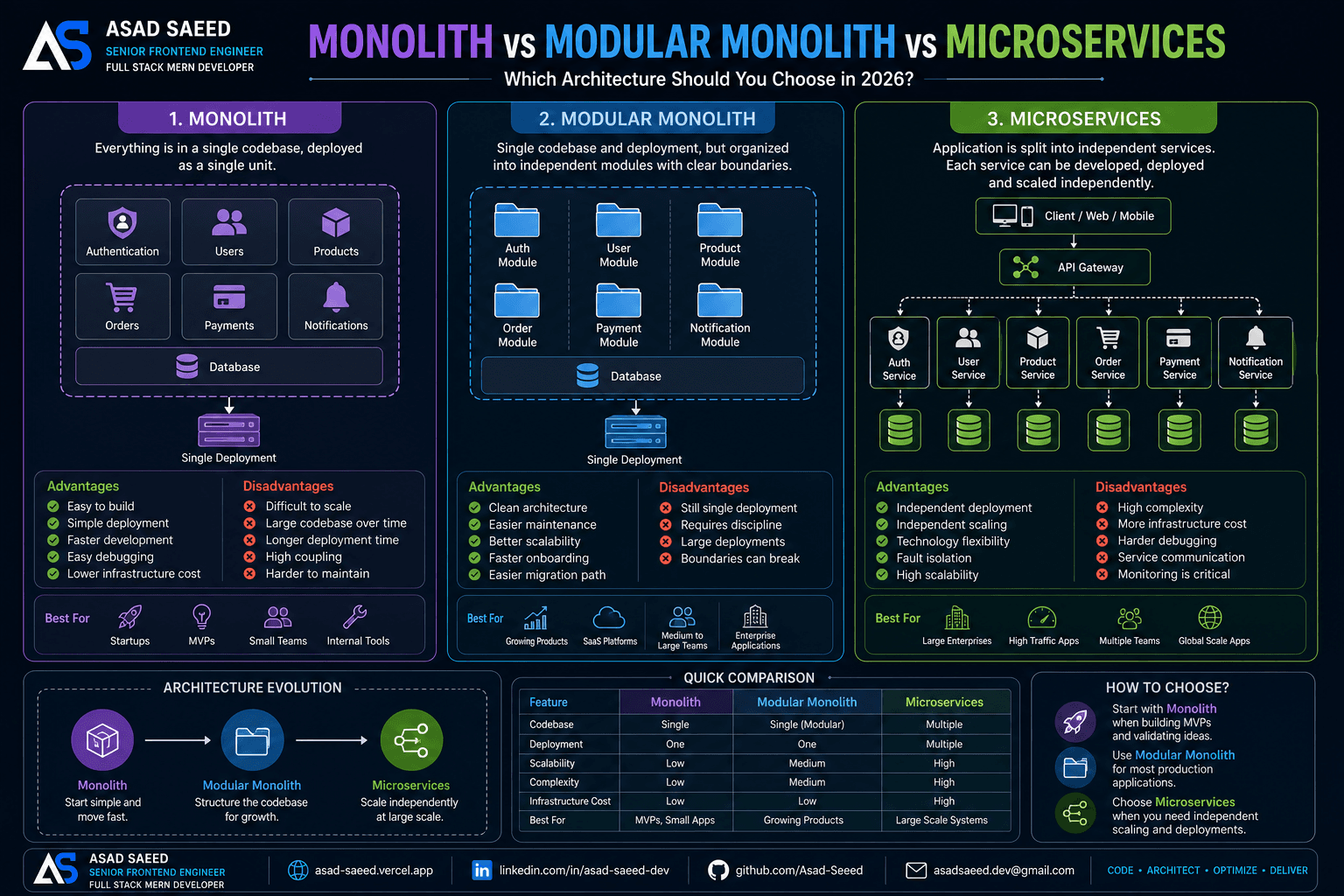
Monolith vs Modular Monolith vs Microservices: Choosing the Right Software Architecture in 2026

Monolith vs Modular Monolith vs Microservices: Choosing the Right Software Architecture in 2026

Learn the differences between Monolith, Modular Monolith, and Microservices architectures. Compare scalability, deployment, complexity, and real-world use cases to choose the right architecture for your next MERN or enterprise application.

SOFTWARE ARCHITECTUREMICROSERVICESSYSTEM DESIGN
Jul 28, 20265 min read
Read
F
Made with ❤️ by Asad Saeed
© 2026 · Asad Saeed
Made with ❤️ by Asad Saeed
F
Aug 5, 20266 min read
Read
Next.js Caching Explained: Request Memoization, Data Cache, Full Route Cache & Router Cache (2026 Guide)

Next.js Caching Explained: Request Memoization, Data Cache, Full Route Cache & Router Cache (2026 Guide)

Learn how Next.js caching works with Request Memoization, Data Cache, Full Route Cache, Router Cache, ISR, revalidation, and cache invalidation. A practical guide for building high-performance, scalable Next.js applications.

NEXT.JSREACT.JSWEB PERFORMANCE
Jul 31, 20266 min read
Read
Monolith vs Modular Monolith vs Microservices: Choosing the Right Software Architecture in 2026

Monolith vs Modular Monolith vs Microservices: Choosing the Right Software Architecture in 2026

Learn the differences between Monolith, Modular Monolith, and Microservices architectures. Compare scalability, deployment, complexity, and real-world use cases to choose the right architecture for your next MERN or enterprise application.

SOFTWARE ARCHITECTUREMICROSERVICESSYSTEM DESIGN
Jul 28, 20265 min read
Read
F
Made with ❤️ by Asad Saeed
© 2026 · Asad Saeed
Made with ❤️ by Asad Saeed
F