Skip to main contentSkip to main content
~/profileLIVE
Asad Saeed
Asad SaeedOpen to WorkSenior Frontend Engineer | MERN Stack Developer
01

Identity

Residence
Lahore, Punjab
Nationality
Pakistani
City
Lahore
Age
26
02

Languages

  • English96%
  • Urdu100%
03

Expertise

React.js95%
Next.js95%
JavaScript / TypeScript95%
HTML5, CSS395%
Tailwind, Bootstrap, Shadcn UI95%
Material UI, SCSS, Styled Components90%
Redux Toolkit, React Query, Zustand92%
REST & GraphQL APIs92%
Git, GitHub, Bitbucket98%
Node.js, Express.js, NestJS85%
MongoDB, PostgreSQL, Prisma80%
WebSockets, Real-Time Systems82%
AI & Automation (n8n, OpenAI)78%
04

Stack

4949 technologies
ReactJSNextJSJavaScriptTypeScriptReact NativeNestJSNode.jsExpress.jsMongoDBPostgreSQLMySQLPrisma ORMFirebaseREST APIGraphQL APIApollo ClientWebSockets / Socket.ioReduxRedux ToolkitReact QueryZustandTailwind CSSShadcn UIMaterial UIBootstrapSCSSCSSModule.cssStyled ComponentsFramer MotionStripe Payment Integrationn8nOpenAI APIAWS LambdaDockerVercelNetlifyGitHub Actions (CI/CD)JestGitGitHubBitbucketPostmanSwaggerJira SoftwareStrapiSanityFigmaAdobe XD
05

Contact

Email
asadsaeed.dev@gmail.com
Phone
+92 3017631644·+92 478730644
Download Resume
HomeSkillsBackgroundPortfolioContact
Chat with Asad
All Posts
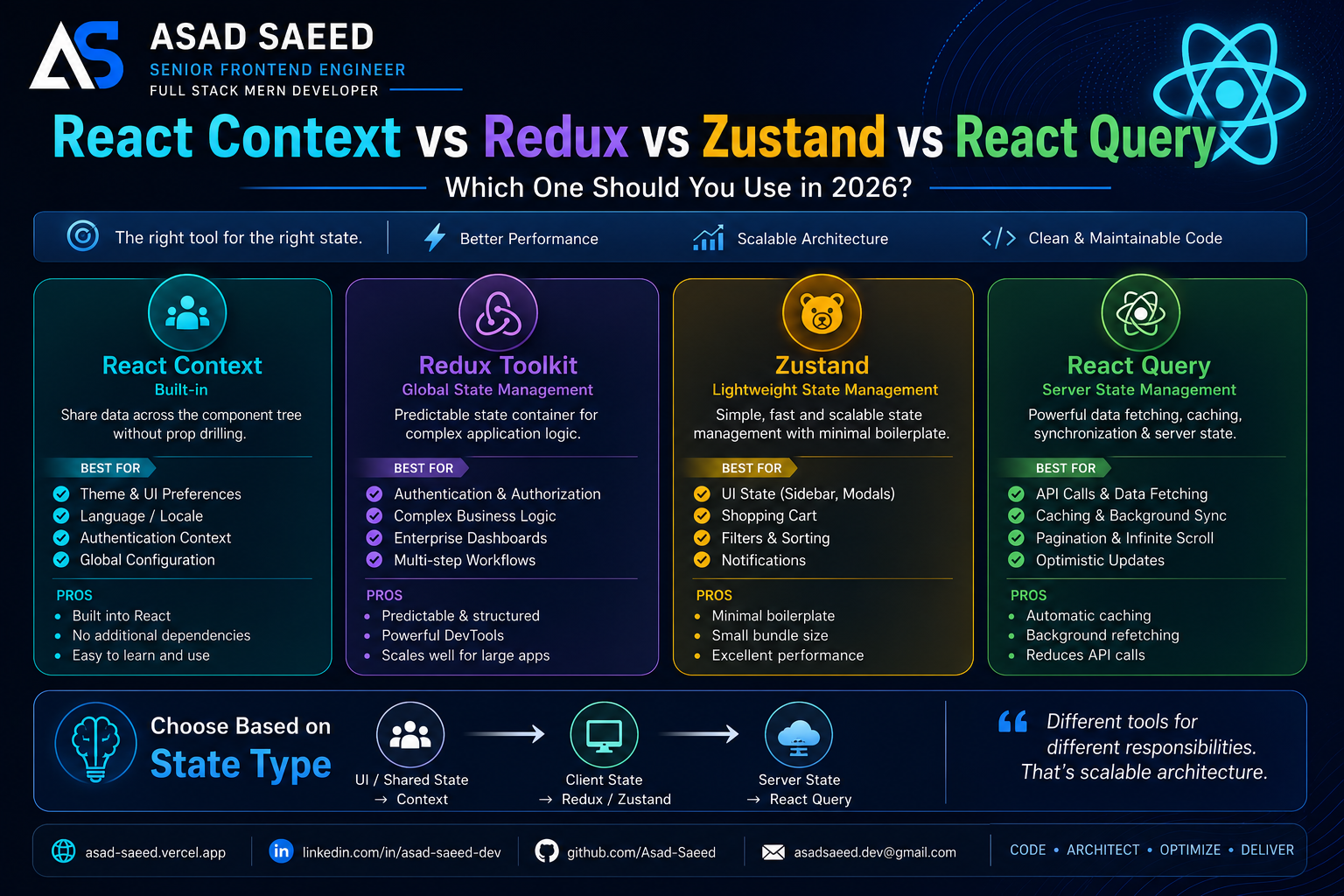
React Context vs Redux vs Zustand vs React Query: Which One Should You Use in 2026?

React Context vs Redux vs Zustand vs React Query: Which One Should You Use in 2026?

REACT STATE MANAGEMENTCONTEXTREDUXZUSTANDREACT QUERYASAD SAEED
July 15, 20265 min readBy Asad Saeed

React Context, Redux, Zustand, and React Query all solve different problems—but choosing the right one can dramatically improve your application's architecture. Here's a practical guide to help you make the right decision.

Introduction

One of the most common debates in the React ecosystem is:

“Should I use React Context, Redux, Zustand, or React Query?”

The truth is, there’s no single “best” solution.

Each library solves a different problem, and one of the biggest mistakes developers make is trying to use one tool for everything.

As applications grow, you’ll likely manage different types of state:

  • Local component state

  • Shared UI state

  • Global application state

  • Server state from APIs

Understanding the purpose of each solution is what separates a senior engineer from someone who simply knows the APIs.

Let’s break them down.

Understanding the Different Types of State

Before choosing a library, it’s important to understand what kind of state you’re managing.

React State
│
├── Local State
│     useState
│
├── Shared UI State
│     React Context
│
├── Global Client State
│     Redux / Zustand
│
└── Server State
      React Query

Not every state belongs in Redux, and not every API response should be stored in Context.

1. React Context

What is it?

React Context is built into React and allows you to share data across multiple components without manually passing props through every level.

It works best for shared UI state that changes infrequently.

Good Use Cases

  • Theme (Light/Dark)

  • Language Selection

  • Authentication Context

  • User Preferences

  • Global Configuration

Pros

✅ Built into React

✅ No additional dependencies

✅ Easy to learn

Cons

❌ Frequent updates can trigger unnecessary re-renders

❌ Not ideal for complex business logic

❌ Difficult to scale in very large applications

Recommendation: Use Context for lightweight shared state — not as a replacement for Redux.

2. Redux Toolkit

What is it?

Redux Toolkit is the official way to use Redux today. It provides a centralized store for managing predictable application state and complex business logic.

It’s especially useful when multiple parts of an application need access to the same data.

Good Use Cases

  • Authentication

  • User Permissions

  • Shopping Cart

  • Multi-step Forms

  • Enterprise Dashboards

  • Complex Business Logic

Pros

✅ Predictable state management

✅ Excellent DevTools

✅ Middleware support

✅ Scales well for enterprise applications

Cons

❌ More boilerplate than other solutions

❌ Overkill for small projects

Recommendation: Choose Redux Toolkit when your application has complex workflows and shared business logic.

3. Zustand

What is it?

Zustand is a lightweight state management library that offers a simple API with minimal boilerplate.

Many startups and modern React projects prefer Zustand because it’s fast, intuitive, and easy to maintain.

Good Use Cases

  • Sidebar State

  • Modals

  • Notifications

  • Shopping Cart

  • Filters

  • UI Preferences

Pros

✅ Minimal setup

✅ Small bundle size

✅ Excellent performance

✅ Easy to understand

Cons

❌ Fewer built-in enterprise features compared to Redux

❌ Not intended for server state

Recommendation: If you need global client-side state without Redux’s complexity, Zustand is an excellent choice.

4. React Query (TanStack Query)

What is it?

React Query is often misunderstood.

It is not a general-purpose state management library.

Its primary responsibility is managing server state — data fetched from APIs.

It handles caching, background refetching, synchronization, loading states, retries, and optimistic updates automatically.

Good Use Cases

  • Fetching Products

  • User Profiles

  • Dashboard Data

  • Analytics

  • Paginated Lists

  • Infinite Scrolling

Pros

✅ Automatic caching

✅ Background synchronization

✅ Optimistic updates

✅ Reduced API calls

✅ Built-in loading and error handling

Cons

❌ Doesn’t replace Redux or Zustand for client-side state

Recommendation: Use React Query whenever you’re working with remote API data.

The Biggest Misconception

Many developers compare Redux and React Query as if they solve the same problem.

They don’t.

❌ Redux vs React Query
This is the wrong comparison.──────────────────────────────Redux / Zustand
↓Client State──────────────────────────────React Query
↓Server State

Your authentication token, theme, or sidebar visibility belongs to client state.

Your products, orders, or users fetched from an API belong to server state.

Which One Should You Choose?

Instead of asking:

“Which library is better?”

Ask:

“What kind of state am I managing?”

Here’s a practical guide:

🎨 Theme
↓
React Context──────────────────────────────🌍 Language
↓React Context──────────────────────────────🛒 Shopping Cart
↓Zustand / Redux Toolkit──────────────────────────────👤 Authentication
↓Redux Toolkit──────────────────────────────📊 Dashboard UI
↓Zustand──────────────────────────────📦 Products API
↓React Query──────────────────────────────📈 Analytics Data
↓React Query──────────────────────────────🏢 Enterprise Business Logic
↓Redux Toolkit

A Modern React Architecture

In many production applications, these tools work together rather than replacing one another.

Next.js Application
│├── React Context
│      Theme
│      Language├── Zustand
│      Sidebar
│      Modal
│      UI State├── Redux Toolkit
│      Authentication
│      User Roles
│      Business Logic└── React Query
       API Calls
       Caching
       Background Sync

Using the right tool for each responsibility leads to a cleaner and more maintainable architecture.

Common Mistakes

❌ Using Context for all application state

❌ Storing API responses in Redux

❌ Using Redux for theme switching

❌ Treating React Query as a replacement for global state

❌ Creating one massive global store

A good architecture separates concerns instead of forcing everything into a single solution.

My Recommendation

If I were starting a modern React or Next.js project today, I’d use:

✅ React Context
→ Theme & Language
✅ Zustand
→ UI State✅ Redux Toolkit
→ Complex Business Logic✅ React Query
→ Server State & API Data

This combination provides excellent scalability while keeping your codebase clean and maintainable.

Final Thoughts

There isn’t a single state management solution that fits every application.

  • React Context is perfect for lightweight shared state.

  • Redux Toolkit excels at managing complex global business logic.

  • Zustand offers a simple and efficient way to manage client-side state.

  • React Query is the best choice for handling server state and API interactions.

As a senior engineer, your goal shouldn’t be to use one library everywhere — it should be to understand which tool is best suited for the problem you’re solving.

Choosing the right architecture early can significantly improve maintainability, performance, and developer experience as your application grows.

About the Author

Asad Saeed

Senior Frontend Engineer | Full Stack MERN Developer

I build scalable web and mobile applications using React.js, Next.js, React Native, TypeScript, Node.js, Express.js, NestJS, MongoDB, PostgreSQL, AWS, and modern CI/CD practices.

Connect with Me

🌐 Portfolio: https://asad-saeed.vercel.app/

💼 LinkedIn: https://linkedin.com/in/asad-saeed-dev

💻 GitHub: https://github.com/Asad-Saeed

📧 Email: asadsaeed.dev@gmail.com

Follow for more content on:

  • React.js

  • Next.js

  • React Native

  • Frontend Architecture

  • System Design

  • TypeScript

  • AWS

  • Full Stack Development

  • Software Engineering

  • CI/CD

#React #NextJS #Redux #Zustand #ReactQuery #TanStackQuery #JavaScript #TypeScript #FrontendDevelopment #SoftwareEngineering #WebDevelopment #AsadSaeed

Asad Saeed

Asad Saeed

Senior Frontend Engineer | MERN Stack Developer

More posts →

Related Posts

Don't Stop Here

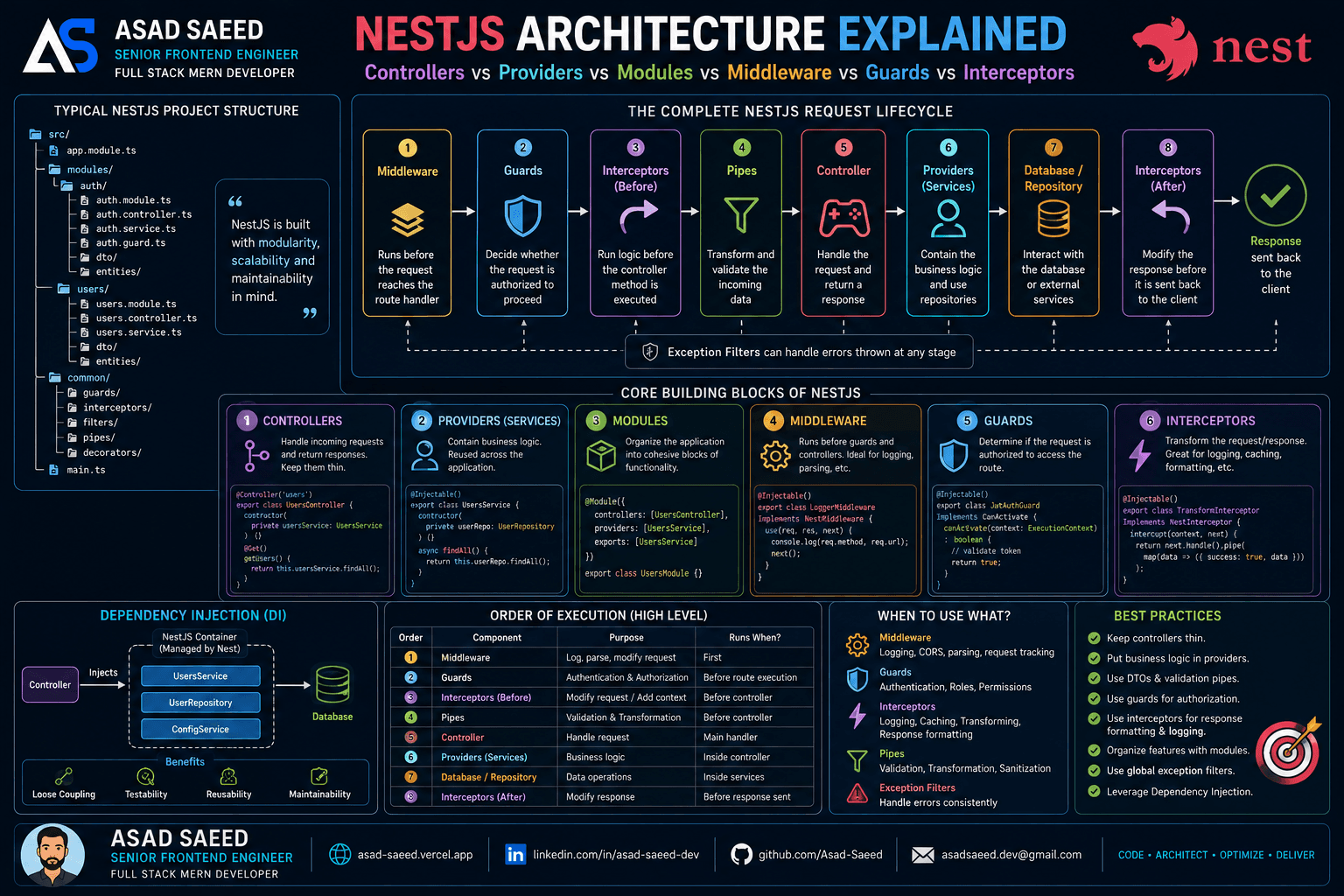
NestJS Architecture Explained: Controllers, Providers, Modules, Middleware, Guards & Interceptors (2026 Guide)

NestJS Architecture Explained: Controllers, Providers, Modules, Middleware, Guards & Interceptors (2026 Guide)

Master the NestJS architecture by understanding Modules, Controllers, Providers, Dependency Injection, Middleware, Guards, Pipes, Interceptors, and Exception Filters. Learn the complete NestJS request lifecycle and build scalable, production-ready backend applications.

NESTJSNODEJSSOFTWARE ARCHITECTURE
© 2026 · Asad Saeed
All Posts
React Context vs Redux vs Zustand vs React Query: Which One Should You Use in 2026?

React Context vs Redux vs Zustand vs React Query: Which One Should You Use in 2026?

REACT STATE MANAGEMENTCONTEXTREDUXZUSTANDREACT QUERYASAD SAEED
July 15, 20265 min readBy Asad Saeed

React Context, Redux, Zustand, and React Query all solve different problems—but choosing the right one can dramatically improve your application's architecture. Here's a practical guide to help you make the right decision.

Introduction

One of the most common debates in the React ecosystem is:

“Should I use React Context, Redux, Zustand, or React Query?”

The truth is, there’s no single “best” solution.

Each library solves a different problem, and one of the biggest mistakes developers make is trying to use one tool for everything.

As applications grow, you’ll likely manage different types of state:

  • Local component state

  • Shared UI state

  • Global application state

  • Server state from APIs

Understanding the purpose of each solution is what separates a senior engineer from someone who simply knows the APIs.

Let’s break them down.

Understanding the Different Types of State

Before choosing a library, it’s important to understand what kind of state you’re managing.

React State
│
├── Local State
│     useState
│
├── Shared UI State
│     React Context
│
├── Global Client State
│     Redux / Zustand
│
└── Server State
      React Query

Not every state belongs in Redux, and not every API response should be stored in Context.

1. React Context

What is it?

React Context is built into React and allows you to share data across multiple components without manually passing props through every level.

It works best for shared UI state that changes infrequently.

Good Use Cases

  • Theme (Light/Dark)

  • Language Selection

  • Authentication Context

  • User Preferences

  • Global Configuration

Pros

✅ Built into React

✅ No additional dependencies

✅ Easy to learn

Cons

❌ Frequent updates can trigger unnecessary re-renders

❌ Not ideal for complex business logic

❌ Difficult to scale in very large applications

Recommendation: Use Context for lightweight shared state — not as a replacement for Redux.

2. Redux Toolkit

What is it?

Redux Toolkit is the official way to use Redux today. It provides a centralized store for managing predictable application state and complex business logic.

It’s especially useful when multiple parts of an application need access to the same data.

Good Use Cases

  • Authentication

  • User Permissions

  • Shopping Cart

  • Multi-step Forms

  • Enterprise Dashboards

  • Complex Business Logic

Pros

✅ Predictable state management

✅ Excellent DevTools

✅ Middleware support

✅ Scales well for enterprise applications

Cons

❌ More boilerplate than other solutions

❌ Overkill for small projects

Recommendation: Choose Redux Toolkit when your application has complex workflows and shared business logic.

3. Zustand

What is it?

Zustand is a lightweight state management library that offers a simple API with minimal boilerplate.

Many startups and modern React projects prefer Zustand because it’s fast, intuitive, and easy to maintain.

Good Use Cases

  • Sidebar State

  • Modals

  • Notifications

  • Shopping Cart

  • Filters

  • UI Preferences

Pros

✅ Minimal setup

✅ Small bundle size

✅ Excellent performance

✅ Easy to understand

Cons

❌ Fewer built-in enterprise features compared to Redux

❌ Not intended for server state

Recommendation: If you need global client-side state without Redux’s complexity, Zustand is an excellent choice.

4. React Query (TanStack Query)

What is it?

React Query is often misunderstood.

It is not a general-purpose state management library.

Its primary responsibility is managing server state — data fetched from APIs.

It handles caching, background refetching, synchronization, loading states, retries, and optimistic updates automatically.

Good Use Cases

  • Fetching Products

  • User Profiles

  • Dashboard Data

  • Analytics

  • Paginated Lists

  • Infinite Scrolling

Pros

✅ Automatic caching

✅ Background synchronization

✅ Optimistic updates

✅ Reduced API calls

✅ Built-in loading and error handling

Cons

❌ Doesn’t replace Redux or Zustand for client-side state

Recommendation: Use React Query whenever you’re working with remote API data.

The Biggest Misconception

Many developers compare Redux and React Query as if they solve the same problem.

They don’t.

❌ Redux vs React Query
This is the wrong comparison.──────────────────────────────Redux / Zustand
↓Client State──────────────────────────────React Query
↓Server State

Your authentication token, theme, or sidebar visibility belongs to client state.

Your products, orders, or users fetched from an API belong to server state.

Which One Should You Choose?

Instead of asking:

“Which library is better?”

Ask:

“What kind of state am I managing?”

Here’s a practical guide:

🎨 Theme
↓
React Context──────────────────────────────🌍 Language
↓React Context──────────────────────────────🛒 Shopping Cart
↓Zustand / Redux Toolkit──────────────────────────────👤 Authentication
↓Redux Toolkit──────────────────────────────📊 Dashboard UI
↓Zustand──────────────────────────────📦 Products API
↓React Query──────────────────────────────📈 Analytics Data
↓React Query──────────────────────────────🏢 Enterprise Business Logic
↓Redux Toolkit

A Modern React Architecture

In many production applications, these tools work together rather than replacing one another.

Next.js Application
│├── React Context
│      Theme
│      Language├── Zustand
│      Sidebar
│      Modal
│      UI State├── Redux Toolkit
│      Authentication
│      User Roles
│      Business Logic└── React Query
       API Calls
       Caching
       Background Sync

Using the right tool for each responsibility leads to a cleaner and more maintainable architecture.

Common Mistakes

❌ Using Context for all application state

❌ Storing API responses in Redux

❌ Using Redux for theme switching

❌ Treating React Query as a replacement for global state

❌ Creating one massive global store

A good architecture separates concerns instead of forcing everything into a single solution.

My Recommendation

If I were starting a modern React or Next.js project today, I’d use:

✅ React Context
→ Theme & Language
✅ Zustand
→ UI State✅ Redux Toolkit
→ Complex Business Logic✅ React Query
→ Server State & API Data

This combination provides excellent scalability while keeping your codebase clean and maintainable.

Final Thoughts

There isn’t a single state management solution that fits every application.

  • React Context is perfect for lightweight shared state.

  • Redux Toolkit excels at managing complex global business logic.

  • Zustand offers a simple and efficient way to manage client-side state.

  • React Query is the best choice for handling server state and API interactions.

As a senior engineer, your goal shouldn’t be to use one library everywhere — it should be to understand which tool is best suited for the problem you’re solving.

Choosing the right architecture early can significantly improve maintainability, performance, and developer experience as your application grows.

About the Author

Asad Saeed

Senior Frontend Engineer | Full Stack MERN Developer

I build scalable web and mobile applications using React.js, Next.js, React Native, TypeScript, Node.js, Express.js, NestJS, MongoDB, PostgreSQL, AWS, and modern CI/CD practices.

Connect with Me

🌐 Portfolio: https://asad-saeed.vercel.app/

💼 LinkedIn: https://linkedin.com/in/asad-saeed-dev

💻 GitHub: https://github.com/Asad-Saeed

📧 Email: asadsaeed.dev@gmail.com

Follow for more content on:

  • React.js

  • Next.js

  • React Native

  • Frontend Architecture

  • System Design

  • TypeScript

  • AWS

  • Full Stack Development

  • Software Engineering

  • CI/CD

#React #NextJS #Redux #Zustand #ReactQuery #TanStackQuery #JavaScript #TypeScript #FrontendDevelopment #SoftwareEngineering #WebDevelopment #AsadSaeed
Asad Saeed

Asad Saeed

Senior Frontend Engineer | MERN Stack Developer

More posts →

Related Posts

Don't Stop Here

NestJS Architecture Explained: Controllers, Providers, Modules, Middleware, Guards & Interceptors (2026 Guide)

NestJS Architecture Explained: Controllers, Providers, Modules, Middleware, Guards & Interceptors (2026 Guide)

Master the NestJS architecture by understanding Modules, Controllers, Providers, Dependency Injection, Middleware, Guards, Pipes, Interceptors, and Exception Filters. Learn the complete NestJS request lifecycle and build scalable, production-ready backend applications.

NESTJSNODEJSSOFTWARE ARCHITECTURE
© 2026 · Asad Saeed
Aug 5, 20266 min read
Read
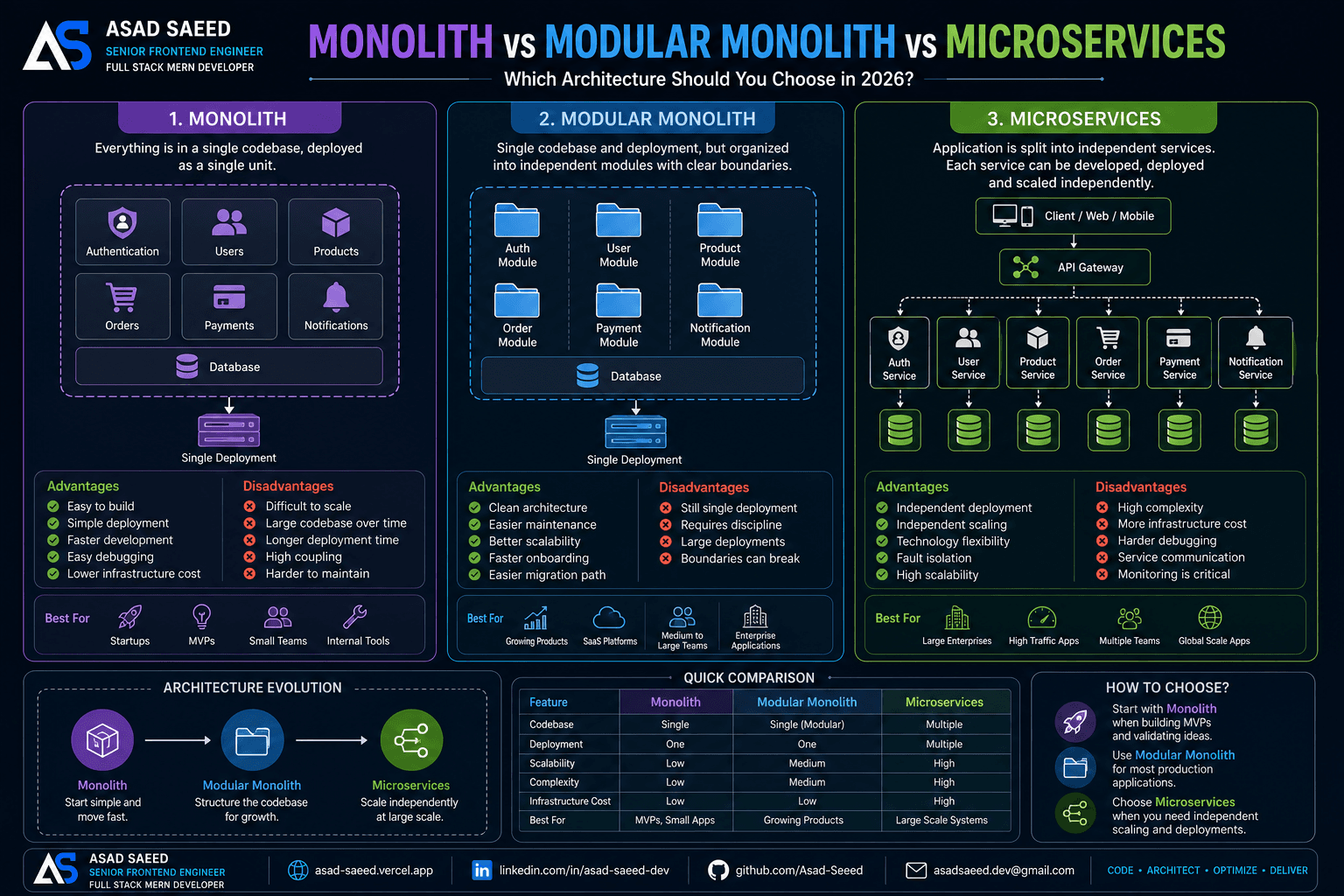
Monolith vs Modular Monolith vs Microservices: Choosing the Right Software Architecture in 2026

Monolith vs Modular Monolith vs Microservices: Choosing the Right Software Architecture in 2026

Learn the differences between Monolith, Modular Monolith, and Microservices architectures. Compare scalability, deployment, complexity, and real-world use cases to choose the right architecture for your next MERN or enterprise application.

SOFTWARE ARCHITECTUREMICROSERVICESSYSTEM DESIGN
Jul 28, 20265 min read
Read
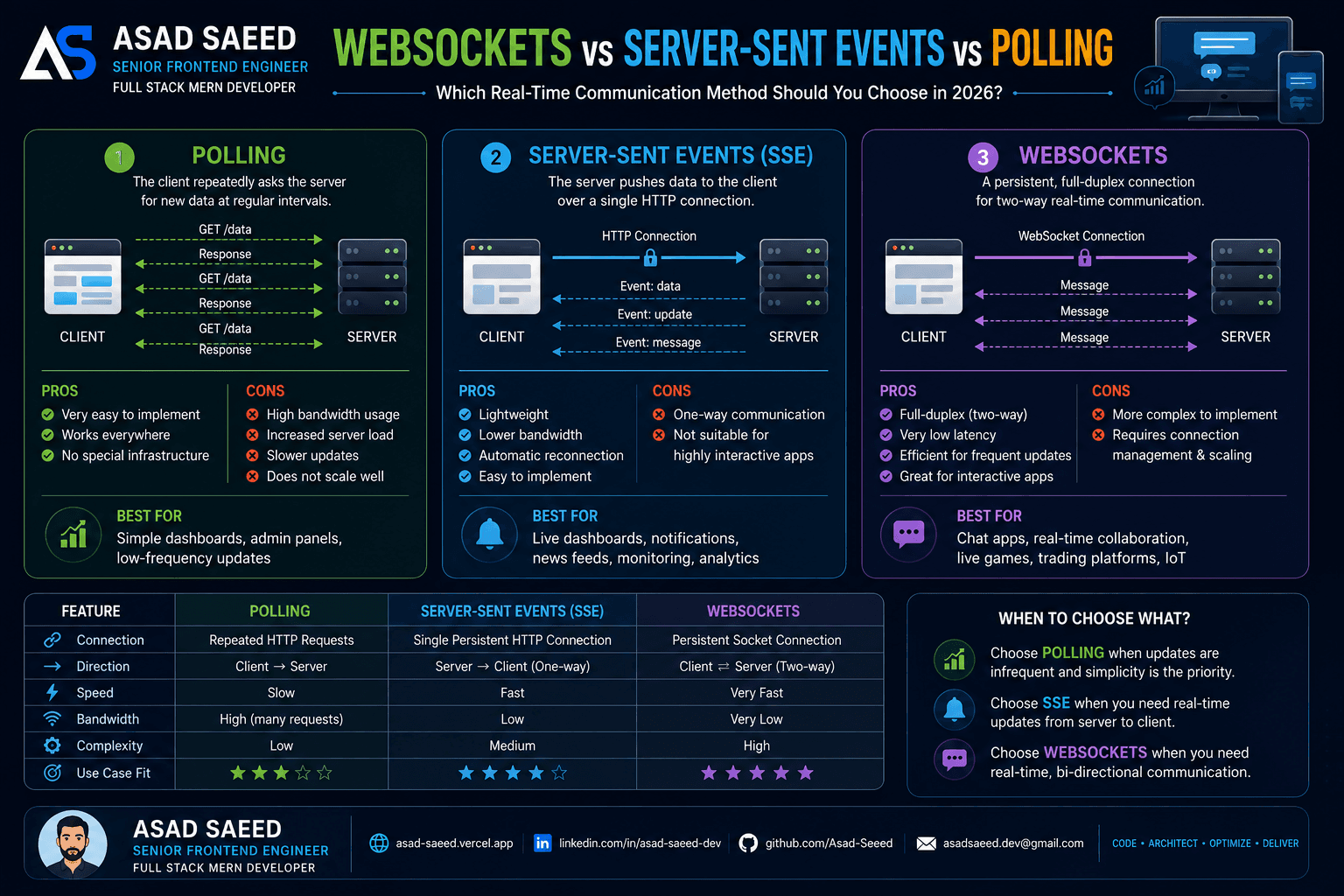
WebSockets vs Server-Sent Events (SSE) vs Polling: Which Real-Time Communication Method Should You Choose in 2026?

WebSockets vs Server-Sent Events (SSE) vs Polling: Which Real-Time Communication Method Should You Choose in 2026?

Learn the differences between WebSockets, Server-Sent Events (SSE), and Polling. Compare performance, scalability, bandwidth, and real-world MERN Stack use cases to choose the best real-time communication method.

WEBSOCKETSWEBSOCKETS VS POLLINGREAL-TIME COMMUNICATION
Jul 24, 20265 min read
Read
F
Made with ❤️ by Asad Saeed
© 2026 · Asad Saeed
Made with ❤️ by Asad Saeed
F
Aug 5, 20266 min read
Read
Monolith vs Modular Monolith vs Microservices: Choosing the Right Software Architecture in 2026

Monolith vs Modular Monolith vs Microservices: Choosing the Right Software Architecture in 2026

Learn the differences between Monolith, Modular Monolith, and Microservices architectures. Compare scalability, deployment, complexity, and real-world use cases to choose the right architecture for your next MERN or enterprise application.

SOFTWARE ARCHITECTUREMICROSERVICESSYSTEM DESIGN
Jul 28, 20265 min read
Read
WebSockets vs Server-Sent Events (SSE) vs Polling: Which Real-Time Communication Method Should You Choose in 2026?

WebSockets vs Server-Sent Events (SSE) vs Polling: Which Real-Time Communication Method Should You Choose in 2026?

Learn the differences between WebSockets, Server-Sent Events (SSE), and Polling. Compare performance, scalability, bandwidth, and real-world MERN Stack use cases to choose the best real-time communication method.

WEBSOCKETSWEBSOCKETS VS POLLINGREAL-TIME COMMUNICATION
Jul 24, 20265 min read
Read
F
Made with ❤️ by Asad Saeed
© 2026 · Asad Saeed
Made with ❤️ by Asad Saeed
F