Skip to main contentSkip to main content
~/profileLIVE
Asad Saeed
Asad SaeedOpen to WorkSenior Frontend Engineer | MERN Stack Developer
01

Identity

Residence
Lahore, Punjab
Nationality
Pakistani
City
Lahore
Age
26
02

Languages

  • English96%
  • Urdu100%
03

Expertise

React.js95%
Next.js95%
JavaScript / TypeScript95%
HTML5, CSS395%
Tailwind, Bootstrap, Shadcn UI95%
Material UI, SCSS, Styled Components90%
Redux Toolkit, React Query, Zustand92%
REST & GraphQL APIs92%
Git, GitHub, Bitbucket98%
Node.js, Express.js, NestJS85%
MongoDB, PostgreSQL, Prisma80%
WebSockets, Real-Time Systems82%
AI & Automation (n8n, OpenAI)78%
04

Stack

4949 technologies
ReactJSNextJSJavaScriptTypeScriptReact NativeNestJSNode.jsExpress.jsMongoDBPostgreSQLMySQLPrisma ORMFirebaseREST APIGraphQL APIApollo ClientWebSockets / Socket.ioReduxRedux ToolkitReact QueryZustandTailwind CSSShadcn UIMaterial UIBootstrapSCSSCSSModule.cssStyled ComponentsFramer MotionStripe Payment Integrationn8nOpenAI APIAWS LambdaDockerVercelNetlifyGitHub Actions (CI/CD)JestGitGitHubBitbucketPostmanSwaggerJira SoftwareStrapiSanityFigmaAdobe XD
05

Contact

Email
asadsaeed.dev@gmail.com
Phone
+92 3017631644·+92 478730644
Download Resume
HomeSkillsBackgroundPortfolioContact
Chat with Asad
All Posts
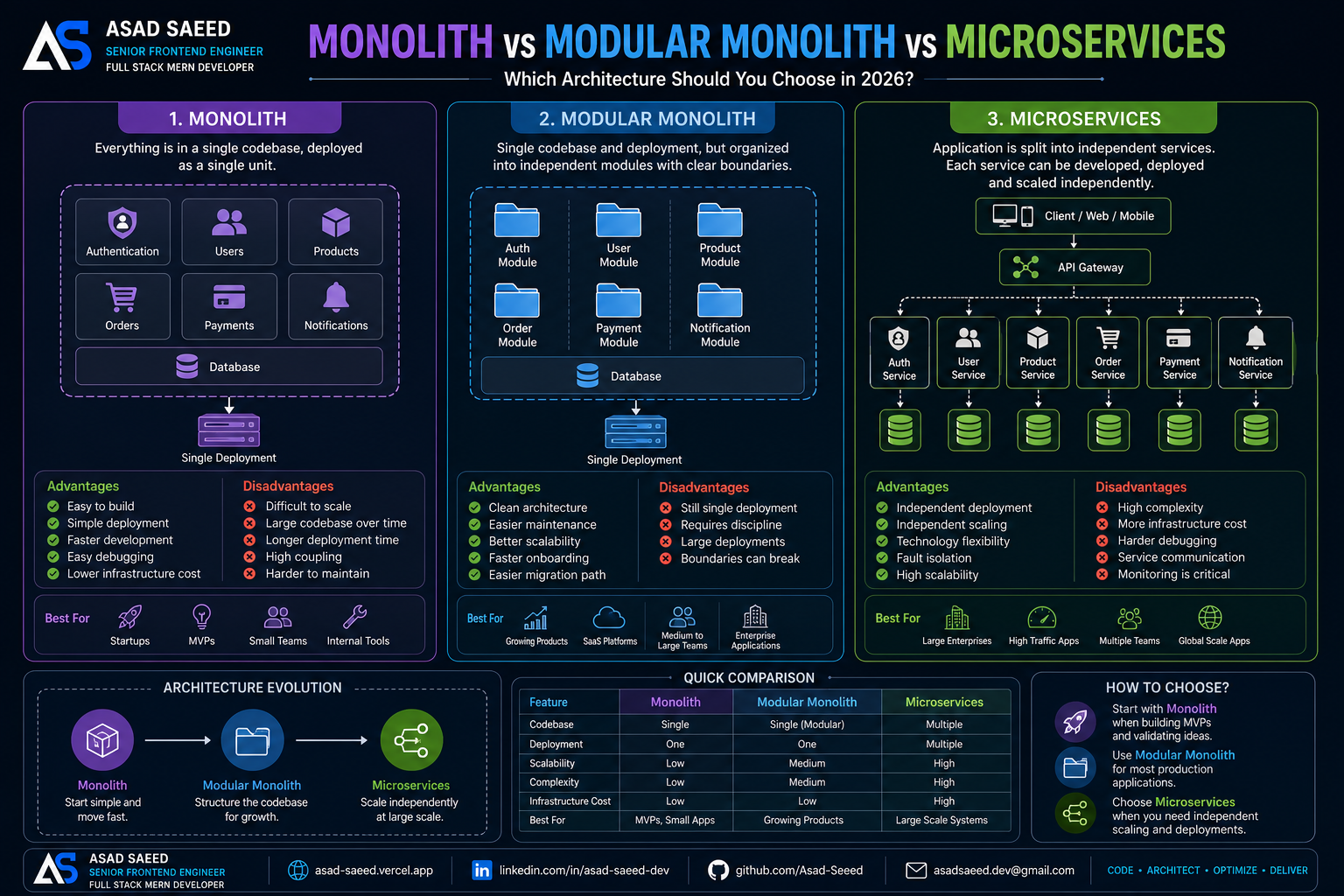
Monolith vs Modular Monolith vs Microservices: Choosing the Right Software Architecture in 2026

Monolith vs Modular Monolith vs Microservices: Choosing the Right Software Architecture in 2026

SOFTWARE ARCHITECTUREMICROSERVICESSYSTEM DESIGNMONOLITHASAD SAEEDMONOLITH VS MICRO
July 28, 20265 min readBy Asad Saeed

Learn the differences between Monolith, Modular Monolith, and Microservices architectures. Compare scalability, deployment, complexity, and real-world use cases to choose the right architecture for your next MERN or enterprise application.

Introduction

One of the biggest architectural decisions you'll make when building software is how to structure your application.

Should you build:

  • A Monolithic application?

  • A Modular Monolith?

  • Or jump directly to Microservices?

Many developers believe microservices are the "modern" solution and should be used for every project.

The reality is quite different.

Companies like Amazon, Netflix, and Uber use microservices today—but they didn't start there. Most successful products begin as a monolith, evolve into a modular monolith, and only adopt microservices when business requirements justify the added complexity.

In this article, we'll compare these three architectural styles, explore their advantages and trade-offs, and discuss when each is the right choice for your MERN application.


Understanding the Three Architectures

Software Architecture

│

├── Monolith

├── Modular Monolith

└── Microservices

Each architecture solves different problems and introduces different trade-offs.


1. Monolithic Architecture

What is a Monolith?

A monolithic application contains all features within a single codebase and is deployed as one unit.

Everything—authentication, users, products, orders, payments, and notifications—runs inside the same application.

MERN Application

│

├── Authentication

├── Users

├── Products

├── Orders

├── Payments

├── Notifications

│

└── One Deployment

Every module shares the same server, database, and deployment pipeline.


Advantages

✅ Easy to build

✅ Simple deployment

✅ Fast development

✅ Easy debugging

✅ Lower infrastructure cost


Disadvantages

❌ Difficult to scale individual features

❌ Large codebase over time

❌ Longer deployment times

❌ High coupling between modules


Best Use Cases

  • Startups

  • MVPs

  • Small businesses

  • Internal tools

  • Admin panels

  • CRM systems


2. Modular Monolith

What is a Modular Monolith?

A Modular Monolith is still one application and one deployment, but the codebase is organized into independent business modules with clear boundaries.

Instead of one large codebase, each feature has its own structure.

src/

├── auth/

├── users/

├── products/

├── orders/

├── payments/

├── notifications/

├── shared/

└── app.ts

Each module owns its controllers, services, models, routes, and business logic.

Modules communicate through well-defined interfaces rather than directly accessing each other's internals.


Advantages

✅ Clean architecture

✅ Easier maintenance

✅ Better scalability than a traditional monolith

✅ Faster onboarding for developers

✅ Easier future migration to microservices


Disadvantages

❌ Still deployed as one application

❌ Requires discipline to maintain module boundaries

❌ Large deployments as the application grows


Best Use Cases

  • SaaS platforms

  • Enterprise applications

  • Growing startups

  • E-commerce platforms

  • Medium-to-large MERN applications


3. Microservices Architecture

What are Microservices?

Microservices split an application into multiple independent services.

Each service is responsible for a specific business capability and can be developed, deployed, and scaled independently.

Client

│

├── Auth Service

├── User Service

├── Product Service

├── Order Service

├── Payment Service

└── Notification Service

Each service may even have its own database and deployment pipeline.


Advantages

✅ Independent deployments

✅ Independent scaling

✅ Technology flexibility

✅ Fault isolation

✅ Smaller codebases


Disadvantages

❌ Higher infrastructure cost

❌ Distributed system complexity

❌ More difficult debugging

❌ Service communication challenges

❌ Monitoring and observability become critical


Best Use Cases

  • Large enterprises

  • High-traffic applications

  • Global SaaS platforms

  • Teams with multiple engineering squads

  • Systems requiring independent scaling


Evolution of a Real Product

Most successful products don't start with microservices.

They evolve over time.

Startup

↓

Monolith

↓

Growing Team

↓

Modular Monolith

↓

Large Scale Business

↓

Microservices

This progression allows teams to keep complexity aligned with business needs.


When Should You Choose Each?

Choose a Monolith if:

  • You're building an MVP.

  • You have a small development team.

  • You need to ship features quickly.

  • Your product requirements are still evolving.


Choose a Modular Monolith if:

  • Your application is growing.

  • Multiple developers work on different features.

  • You want clean architecture.

  • You may migrate to microservices in the future.


Choose Microservices if:

  • Different services need independent scaling.

  • Multiple teams own different domains.

  • You require independent deployments.

  • Your application serves millions of users or handles highly distributed workloads.


A Practical MERN Example

Imagine you're building an e-commerce platform.

Stage 1 – Monolith

Everything lives in one application:

  • Authentication

  • Products

  • Orders

  • Payments

  • Inventory

  • Notifications

Perfect for launching quickly.


Stage 2 – Modular Monolith

As the product grows, organize it into modules:

src/

├── auth/

├── catalog/

├── orders/

├── inventory/

├── payments/

├── notifications/

└── shared/

The application remains a single deployment, but the codebase is easier to maintain.


Stage 3 – Microservices

Once traffic and team size increase:

API Gateway

│

├── Auth Service

├── Catalog Service

├── Order Service

├── Inventory Service

├── Payment Service

└── Notification Service

Now each service can scale and deploy independently.


Common Mistakes

❌ Choosing microservices because they're "trendy."

❌ Building distributed systems before validating the product.

❌ Creating tightly coupled microservices.

❌ Ignoring module boundaries in a monolith.

❌ Sharing databases across unrelated services.

❌ Introducing unnecessary complexity for small applications.


My Recommendation

For most MERN applications in 2026:

  • Monolith is the fastest way to build and validate an idea.

  • Modular Monolith is the ideal architecture for most production applications because it balances simplicity, maintainability, and scalability.

  • Microservices should be adopted only when business requirements, team size, or scaling needs justify the additional operational complexity.

Architecture should evolve with your product—not with industry trends.


Final Thoughts

There is no universally "best" architecture.

The right choice depends on your team's size, product maturity, traffic, deployment requirements, and long-term goals.

A well-structured monolith can outperform a poorly designed microservices system.

Likewise, forcing a growing enterprise to remain a monolith can eventually slow development and limit scalability.

As a senior engineer, your responsibility isn't to choose the most complex architecture—it's to choose the architecture that best solves today's problems while allowing room for tomorrow's growth.

Remember:

Good architecture minimizes unnecessary complexity while maximizing maintainability and scalability.


About the Author

Asad Saeed

Senior Frontend Engineer | Full Stack MERN Developer

I build scalable web and mobile applications using React.js, Next.js, React Native, TypeScript, Node.js, Express.js, NestJS, MongoDB, PostgreSQL, Redis, AWS, Docker, and modern CI/CD pipelines.

Connect with Me

🌐 Portfolio: https://asad-saeed.vercel.app/

💼 LinkedIn: https://linkedin.com/in/asad-saeed-dev

💻 GitHub: https://github.com/Asad-Saeed

📧 Email: asadsaeed.dev@gmail.com


Follow for more content on:

  • MERN Stack

  • React.js

  • Next.js

  • Node.js

  • Software Architecture

  • System Design

  • Backend Development

  • Cloud & AWS

  • Docker

  • CI/CD

  • Software Engineering

#SoftwareArchitecture #Monolith #Microservices #ModularMonolith #MERN #NodeJS #React #NextJS #SystemDesign #BackendDevelopment #SoftwareEngineering #WebDevelopment #AsadSaeed

Asad Saeed

Asad Saeed

Senior Frontend Engineer | MERN Stack Developer

More posts →

Related Posts

Don't Stop Here

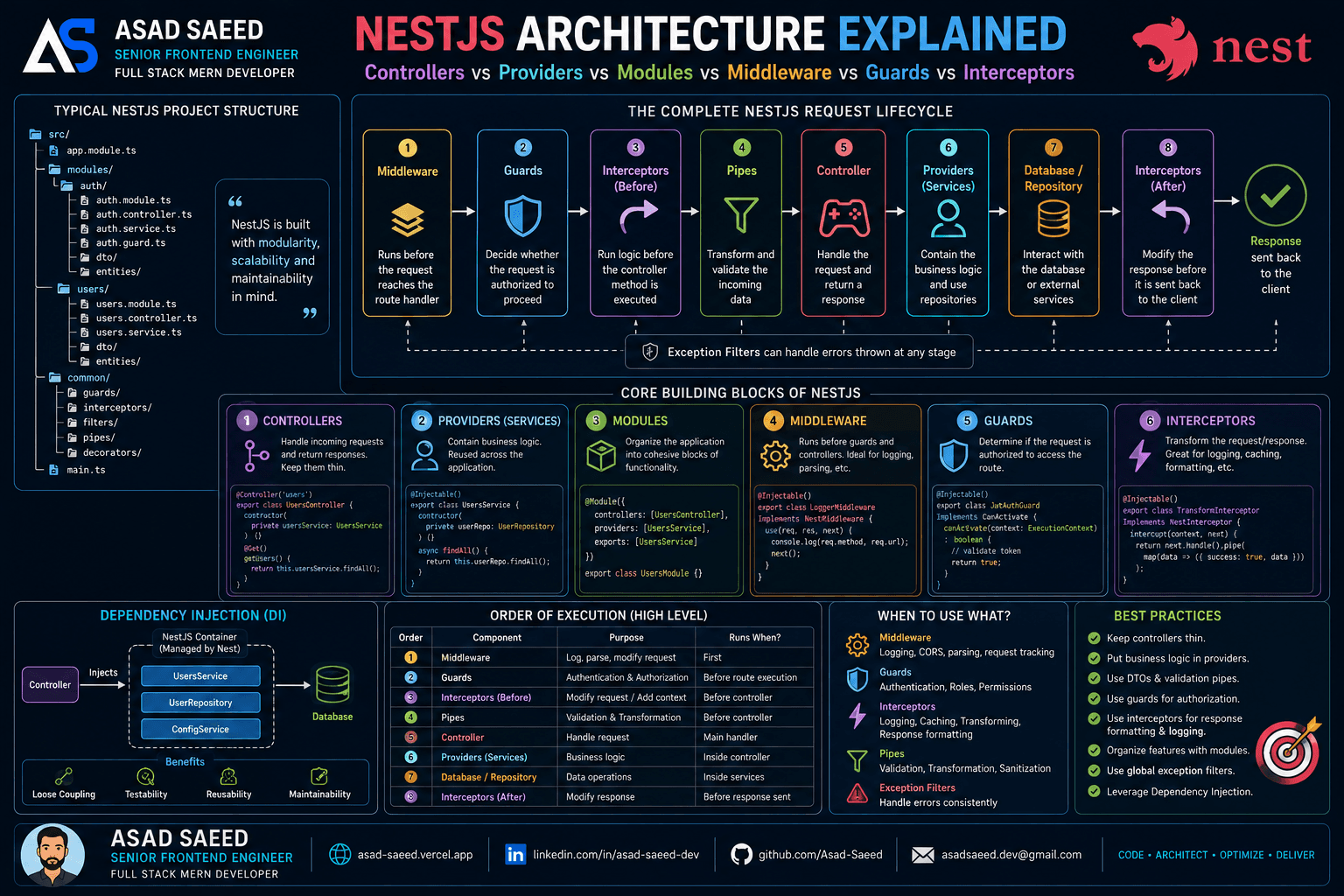
NestJS Architecture Explained: Controllers, Providers, Modules, Middleware, Guards & Interceptors (2026 Guide)

NestJS Architecture Explained: Controllers, Providers, Modules, Middleware, Guards & Interceptors (2026 Guide)

Master the NestJS architecture by understanding Modules, Controllers, Providers, Dependency Injection, Middleware, Guards, Pipes, Interceptors, and Exception Filters. Learn the complete NestJS request lifecycle and build scalable, production-ready backend applications.

NESTJSNODEJSSOFTWARE ARCHITECTURE
© 2026 · Asad Saeed
All Posts
Monolith vs Modular Monolith vs Microservices: Choosing the Right Software Architecture in 2026

Monolith vs Modular Monolith vs Microservices: Choosing the Right Software Architecture in 2026

SOFTWARE ARCHITECTUREMICROSERVICESSYSTEM DESIGNMONOLITHASAD SAEEDMONOLITH VS MICRO
July 28, 20265 min readBy Asad Saeed

Learn the differences between Monolith, Modular Monolith, and Microservices architectures. Compare scalability, deployment, complexity, and real-world use cases to choose the right architecture for your next MERN or enterprise application.

Introduction

One of the biggest architectural decisions you'll make when building software is how to structure your application.

Should you build:

  • A Monolithic application?

  • A Modular Monolith?

  • Or jump directly to Microservices?

Many developers believe microservices are the "modern" solution and should be used for every project.

The reality is quite different.

Companies like Amazon, Netflix, and Uber use microservices today—but they didn't start there. Most successful products begin as a monolith, evolve into a modular monolith, and only adopt microservices when business requirements justify the added complexity.

In this article, we'll compare these three architectural styles, explore their advantages and trade-offs, and discuss when each is the right choice for your MERN application.


Understanding the Three Architectures

Software Architecture

│

├── Monolith

├── Modular Monolith

└── Microservices

Each architecture solves different problems and introduces different trade-offs.


1. Monolithic Architecture

What is a Monolith?

A monolithic application contains all features within a single codebase and is deployed as one unit.

Everything—authentication, users, products, orders, payments, and notifications—runs inside the same application.

MERN Application

│

├── Authentication

├── Users

├── Products

├── Orders

├── Payments

├── Notifications

│

└── One Deployment

Every module shares the same server, database, and deployment pipeline.


Advantages

✅ Easy to build

✅ Simple deployment

✅ Fast development

✅ Easy debugging

✅ Lower infrastructure cost


Disadvantages

❌ Difficult to scale individual features

❌ Large codebase over time

❌ Longer deployment times

❌ High coupling between modules


Best Use Cases

  • Startups

  • MVPs

  • Small businesses

  • Internal tools

  • Admin panels

  • CRM systems


2. Modular Monolith

What is a Modular Monolith?

A Modular Monolith is still one application and one deployment, but the codebase is organized into independent business modules with clear boundaries.

Instead of one large codebase, each feature has its own structure.

src/

├── auth/

├── users/

├── products/

├── orders/

├── payments/

├── notifications/

├── shared/

└── app.ts

Each module owns its controllers, services, models, routes, and business logic.

Modules communicate through well-defined interfaces rather than directly accessing each other's internals.


Advantages

✅ Clean architecture

✅ Easier maintenance

✅ Better scalability than a traditional monolith

✅ Faster onboarding for developers

✅ Easier future migration to microservices


Disadvantages

❌ Still deployed as one application

❌ Requires discipline to maintain module boundaries

❌ Large deployments as the application grows


Best Use Cases

  • SaaS platforms

  • Enterprise applications

  • Growing startups

  • E-commerce platforms

  • Medium-to-large MERN applications


3. Microservices Architecture

What are Microservices?

Microservices split an application into multiple independent services.

Each service is responsible for a specific business capability and can be developed, deployed, and scaled independently.

Client

│

├── Auth Service

├── User Service

├── Product Service

├── Order Service

├── Payment Service

└── Notification Service

Each service may even have its own database and deployment pipeline.


Advantages

✅ Independent deployments

✅ Independent scaling

✅ Technology flexibility

✅ Fault isolation

✅ Smaller codebases


Disadvantages

❌ Higher infrastructure cost

❌ Distributed system complexity

❌ More difficult debugging

❌ Service communication challenges

❌ Monitoring and observability become critical


Best Use Cases

  • Large enterprises

  • High-traffic applications

  • Global SaaS platforms

  • Teams with multiple engineering squads

  • Systems requiring independent scaling


Evolution of a Real Product

Most successful products don't start with microservices.

They evolve over time.

Startup

↓

Monolith

↓

Growing Team

↓

Modular Monolith

↓

Large Scale Business

↓

Microservices

This progression allows teams to keep complexity aligned with business needs.


When Should You Choose Each?

Choose a Monolith if:

  • You're building an MVP.

  • You have a small development team.

  • You need to ship features quickly.

  • Your product requirements are still evolving.


Choose a Modular Monolith if:

  • Your application is growing.

  • Multiple developers work on different features.

  • You want clean architecture.

  • You may migrate to microservices in the future.


Choose Microservices if:

  • Different services need independent scaling.

  • Multiple teams own different domains.

  • You require independent deployments.

  • Your application serves millions of users or handles highly distributed workloads.


A Practical MERN Example

Imagine you're building an e-commerce platform.

Stage 1 – Monolith

Everything lives in one application:

  • Authentication

  • Products

  • Orders

  • Payments

  • Inventory

  • Notifications

Perfect for launching quickly.


Stage 2 – Modular Monolith

As the product grows, organize it into modules:

src/

├── auth/

├── catalog/

├── orders/

├── inventory/

├── payments/

├── notifications/

└── shared/

The application remains a single deployment, but the codebase is easier to maintain.


Stage 3 – Microservices

Once traffic and team size increase:

API Gateway

│

├── Auth Service

├── Catalog Service

├── Order Service

├── Inventory Service

├── Payment Service

└── Notification Service

Now each service can scale and deploy independently.


Common Mistakes

❌ Choosing microservices because they're "trendy."

❌ Building distributed systems before validating the product.

❌ Creating tightly coupled microservices.

❌ Ignoring module boundaries in a monolith.

❌ Sharing databases across unrelated services.

❌ Introducing unnecessary complexity for small applications.


My Recommendation

For most MERN applications in 2026:

  • Monolith is the fastest way to build and validate an idea.

  • Modular Monolith is the ideal architecture for most production applications because it balances simplicity, maintainability, and scalability.

  • Microservices should be adopted only when business requirements, team size, or scaling needs justify the additional operational complexity.

Architecture should evolve with your product—not with industry trends.


Final Thoughts

There is no universally "best" architecture.

The right choice depends on your team's size, product maturity, traffic, deployment requirements, and long-term goals.

A well-structured monolith can outperform a poorly designed microservices system.

Likewise, forcing a growing enterprise to remain a monolith can eventually slow development and limit scalability.

As a senior engineer, your responsibility isn't to choose the most complex architecture—it's to choose the architecture that best solves today's problems while allowing room for tomorrow's growth.

Remember:

Good architecture minimizes unnecessary complexity while maximizing maintainability and scalability.


About the Author

Asad Saeed

Senior Frontend Engineer | Full Stack MERN Developer

I build scalable web and mobile applications using React.js, Next.js, React Native, TypeScript, Node.js, Express.js, NestJS, MongoDB, PostgreSQL, Redis, AWS, Docker, and modern CI/CD pipelines.

Connect with Me

🌐 Portfolio: https://asad-saeed.vercel.app/

💼 LinkedIn: https://linkedin.com/in/asad-saeed-dev

💻 GitHub: https://github.com/Asad-Saeed

📧 Email: asadsaeed.dev@gmail.com


Follow for more content on:

  • MERN Stack

  • React.js

  • Next.js

  • Node.js

  • Software Architecture

  • System Design

  • Backend Development

  • Cloud & AWS

  • Docker

  • CI/CD

  • Software Engineering

#SoftwareArchitecture #Monolith #Microservices #ModularMonolith #MERN #NodeJS #React #NextJS #SystemDesign #BackendDevelopment #SoftwareEngineering #WebDevelopment #AsadSaeed
Asad Saeed

Asad Saeed

Senior Frontend Engineer | MERN Stack Developer

More posts →

Related Posts

Don't Stop Here

NestJS Architecture Explained: Controllers, Providers, Modules, Middleware, Guards & Interceptors (2026 Guide)

NestJS Architecture Explained: Controllers, Providers, Modules, Middleware, Guards & Interceptors (2026 Guide)

Master the NestJS architecture by understanding Modules, Controllers, Providers, Dependency Injection, Middleware, Guards, Pipes, Interceptors, and Exception Filters. Learn the complete NestJS request lifecycle and build scalable, production-ready backend applications.

NESTJSNODEJSSOFTWARE ARCHITECTURE
© 2026 · Asad Saeed
Aug 5, 20266 min read
Read
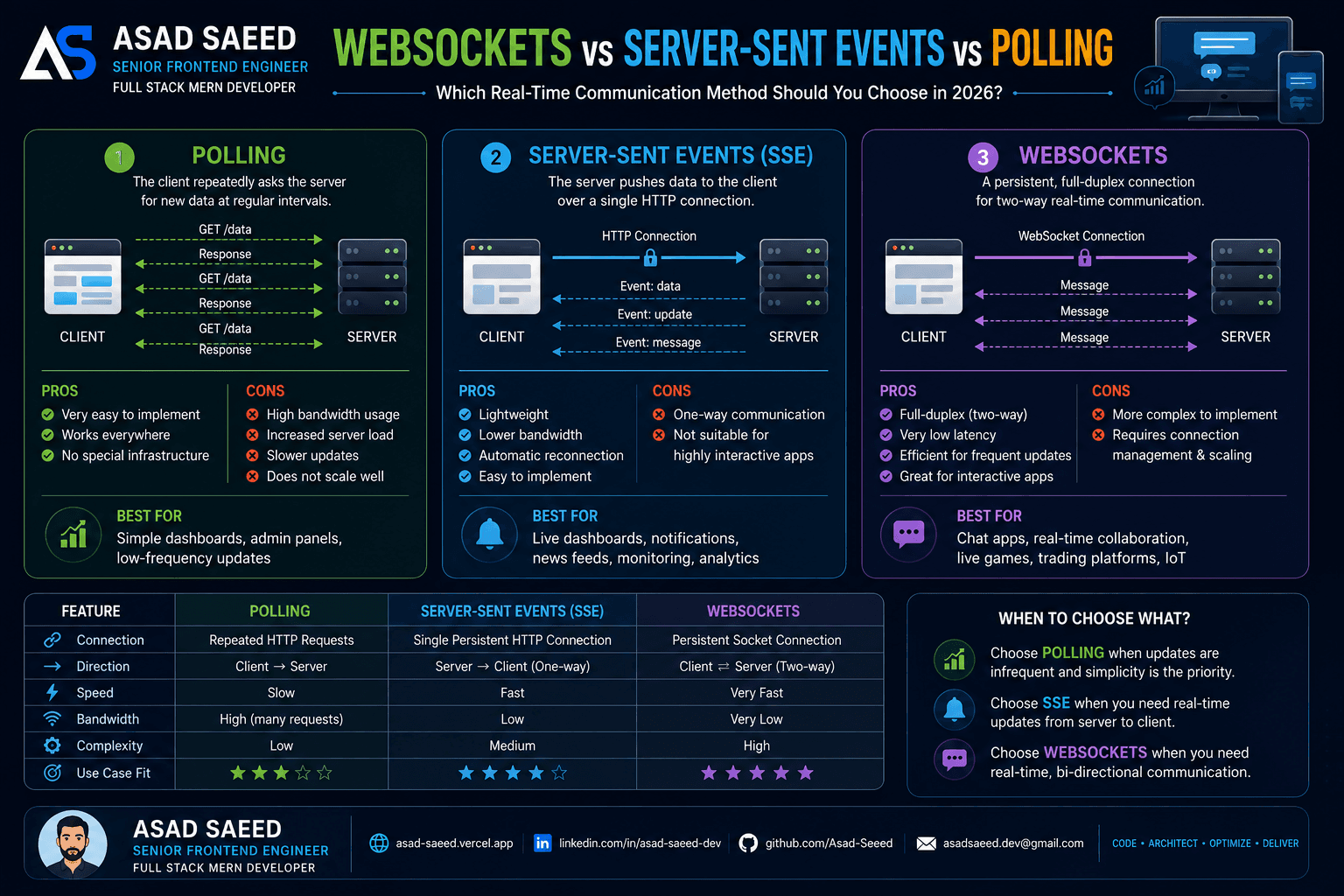
WebSockets vs Server-Sent Events (SSE) vs Polling: Which Real-Time Communication Method Should You Choose in 2026?

WebSockets vs Server-Sent Events (SSE) vs Polling: Which Real-Time Communication Method Should You Choose in 2026?

Learn the differences between WebSockets, Server-Sent Events (SSE), and Polling. Compare performance, scalability, bandwidth, and real-world MERN Stack use cases to choose the best real-time communication method.

WEBSOCKETSWEBSOCKETS VS POLLINGREAL-TIME COMMUNICATION
Jul 24, 20265 min read
Read
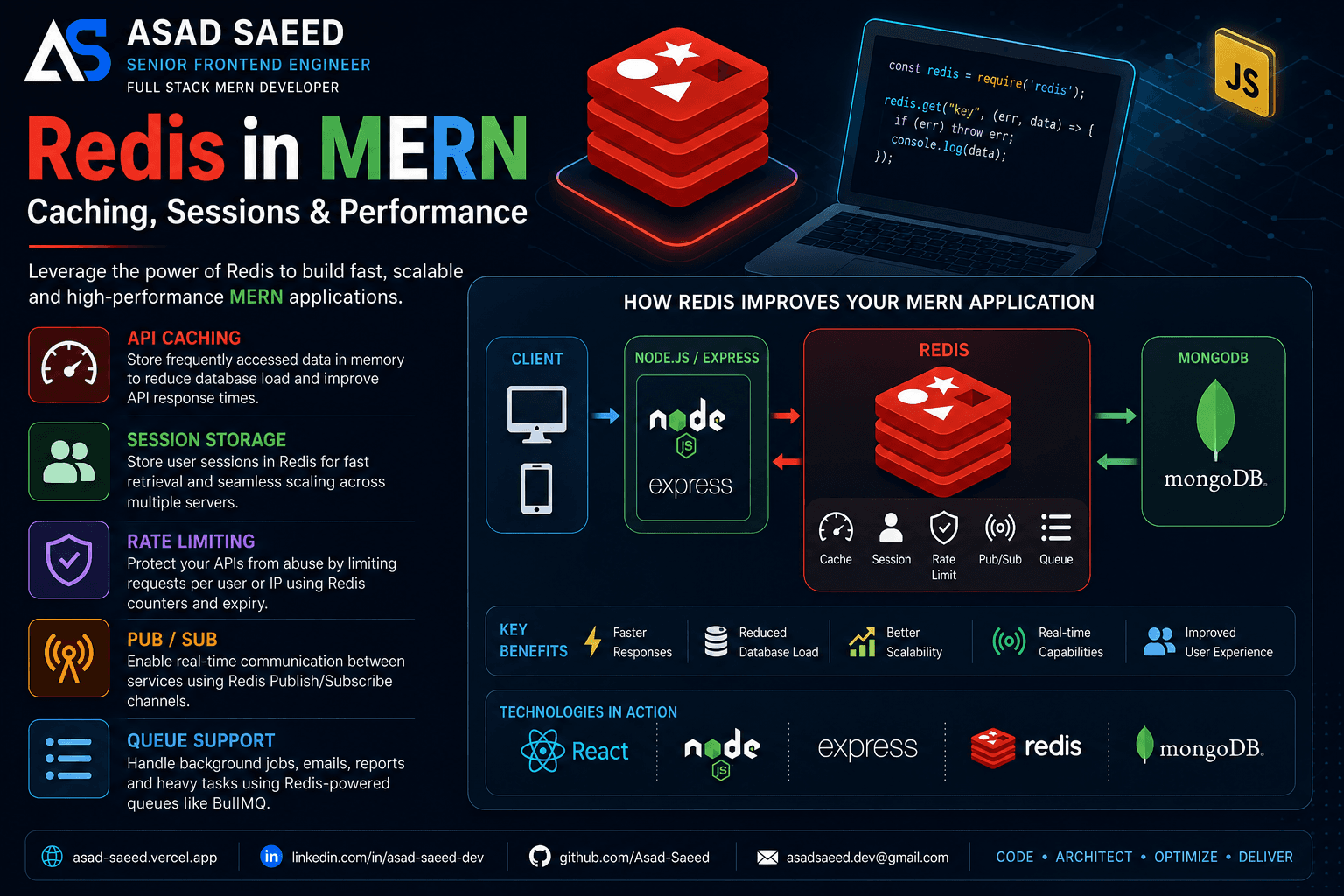
Redis in MERN: Caching, Sessions & Performance — A Practical Guide for Scalable Applications (2026)

Redis in MERN: Caching, Sessions & Performance — A Practical Guide for Scalable Applications (2026)

Learn how Redis improves MERN applications with API caching, session storage, rate limiting, Pub/Sub messaging, queues, and performance optimization. A practical guide for building fast and scalable Node.js applications.

REDISNODEJSMERN
Jul 21, 20265 min read
Read
F
Made with ❤️ by Asad Saeed
© 2026 · Asad Saeed
Made with ❤️ by Asad Saeed
F
Aug 5, 20266 min read
Read
WebSockets vs Server-Sent Events (SSE) vs Polling: Which Real-Time Communication Method Should You Choose in 2026?

WebSockets vs Server-Sent Events (SSE) vs Polling: Which Real-Time Communication Method Should You Choose in 2026?

Learn the differences between WebSockets, Server-Sent Events (SSE), and Polling. Compare performance, scalability, bandwidth, and real-world MERN Stack use cases to choose the best real-time communication method.

WEBSOCKETSWEBSOCKETS VS POLLINGREAL-TIME COMMUNICATION
Jul 24, 20265 min read
Read
Redis in MERN: Caching, Sessions & Performance — A Practical Guide for Scalable Applications (2026)

Redis in MERN: Caching, Sessions & Performance — A Practical Guide for Scalable Applications (2026)

Learn how Redis improves MERN applications with API caching, session storage, rate limiting, Pub/Sub messaging, queues, and performance optimization. A practical guide for building fast and scalable Node.js applications.

REDISNODEJSMERN
Jul 21, 20265 min read
Read
F
Made with ❤️ by Asad Saeed
© 2026 · Asad Saeed
Made with ❤️ by Asad Saeed
F